

 LASIKSelf Test!
 Call Now9910430391
 BookAppointment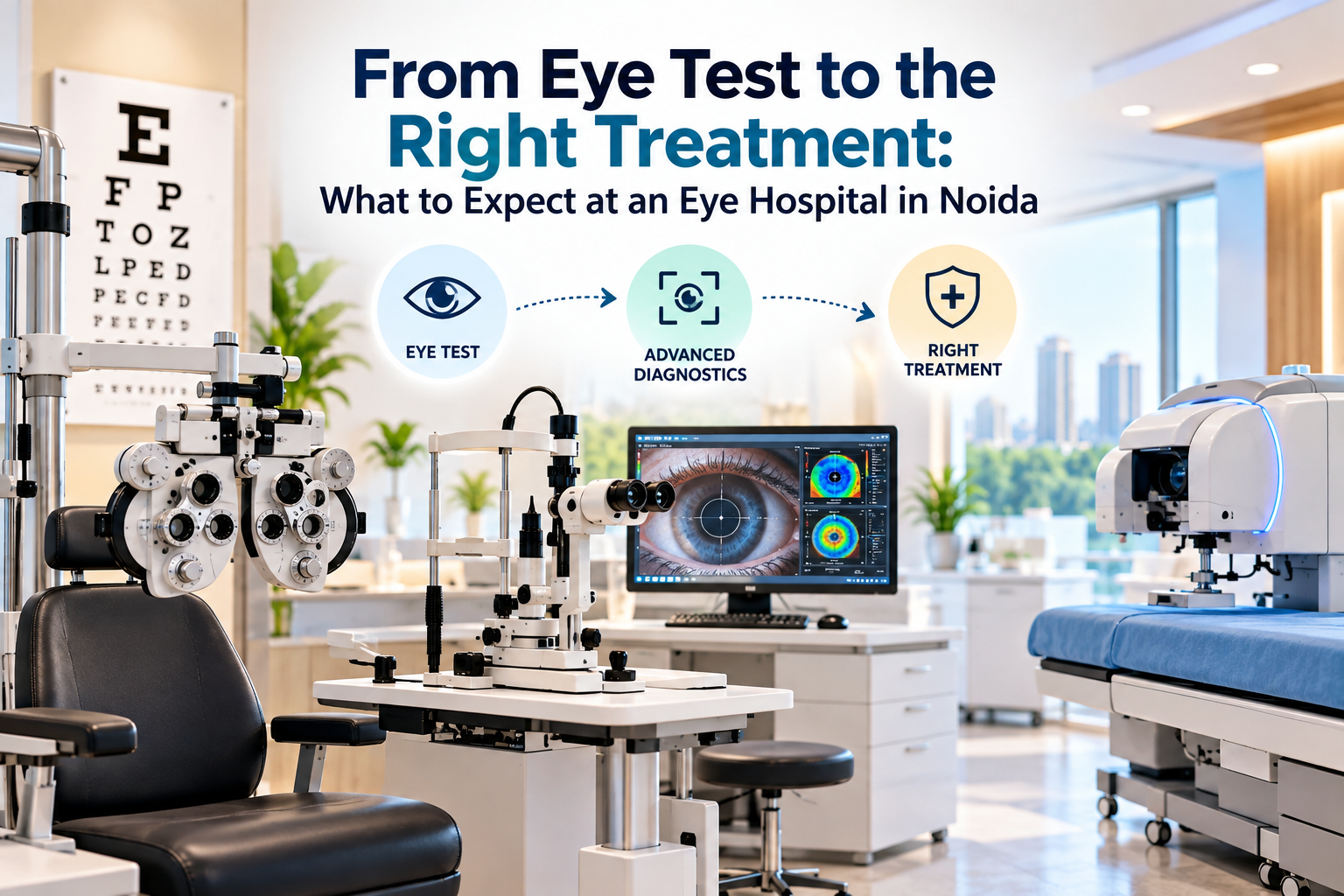
When people search for an eye hospital in Noida, they are often looking for more than a nearby clinic. They may be dealing with blurred vision, changing spectacle power, headaches, glare while driving, dry eyes, a suspected cataract, a retina or glaucoma concern, or simply the wish to reduce dependence on glasses. The most useful eye-care visit is therefore not a one-size-fits-all consultation. It is a structured process that first identifies the cause of the visual problem and then matches the patient with the right specialist, diagnostic tests and treatment pathway.
For patients considering vision correction, this distinction becomes especially important. A person searching for a LASIK hospital in Noida may eventually be advised LASIK, Contoura Vision, SILK, PRK, an implantable collamer lens (ICL), or no refractive procedure at all. The correct choice depends on factors such as age, stability of spectacle power, corneal shape and thickness, tear-film health, pupil characteristics, refractive error, retinal status and overall eye health. That is why a comprehensive evaluation matters more than choosing a procedure by name.
ICARE Eye Hospital & Post Graduate Institute provides tertiary eye care in Noida and lists services across cataract, refractive surgery, glaucoma, vitreoretina and uvea, cornea, pediatric ophthalmology, oculoplasty, neuro-ophthalmology, low vision, emergency eye care and other ophthalmic specialties. For patients who want to understand the hospital’s broader services, visit https://www.icarehospital.org/.
Why a Comprehensive Eye Evaluation Should Come Before Treatment
Symptoms such as blurred vision, eye strain or difficulty seeing at night can have very different causes. A refractive error may be corrected with spectacles, contact lenses or an appropriate refractive procedure. A cataract can reduce clarity and contrast because the natural lens becomes cloudy. Glaucoma can damage the optic nerve, sometimes without obvious early symptoms. Retinal disorders may affect central or peripheral vision. Corneal conditions and dry eye can also alter visual quality and may influence whether laser vision correction is advisable.
A good consultation therefore begins by answering a basic question: what is actually causing the visual complaint? Only after that question is answered should the discussion move to treatment options. For patients comparing eye doctors in Noida, it is useful to look for access to subspecialty care because one patient may need a cornea or refractive specialist while another may need a retina, glaucoma, pediatric or cataract specialist.
What Usually Happens During a Detailed Eye Check-Up
1. Vision and refraction assessment
The visit typically starts with measurement of visual acuity and refractive error. This helps determine how clearly each eye sees and whether spectacles or contact lenses can improve the vision. For patients considering laser vision correction, the stability of the prescription is important because a changing prescription may affect candidacy.
2. Slit-lamp examination
A slit-lamp examination allows the ophthalmologist to inspect structures at the front of the eye, including the cornea, anterior chamber, iris and lens. This can help identify dry-eye signs, corneal scars, inflammation, early cataract and other abnormalities that may influence treatment planning.
3. Eye pressure and optic nerve assessment
Eye pressure measurement can be part of glaucoma screening, but glaucoma assessment is not based on pressure alone. Depending on the findings and risk factors, additional evaluation of the optic nerve, visual field or retinal nerve fibre layer may be required.
4. Dilated retina examination when clinically indicated
A dilated examination may be advised to examine the retina and optic nerve more completely. This is particularly relevant for patients with high myopia, diabetes, flashes and floaters, retinal symptoms or before certain surgical decisions.
5. Specialised diagnostic testing
Additional tests depend on the clinical question. Corneal mapping and pachymetry may be important before laser vision correction. Optical coherence tomography (OCT), visual field testing, retinal imaging or other investigations may be used when the ophthalmologist needs more information about the retina, macula, optic nerve or cornea.
Planning Vision Correction: Why LASIK Screening Is More Important Than the Procedure Name
Many patients arrive after searching online for LASIK, blade-free LASIK, Contoura Vision, SILK laser surgery or ICL surgery in Noida. These searches are useful for learning, but they should not be treated as a self-diagnosis. The American Academy of Ophthalmology notes that LASIK suitability depends on factors such as adult age, a sufficiently stable prescription, a healthy and adequately thick cornea, suitable refractive error and overall eye health. Certain conditions, including severe dry eye, keratoconus, visually significant cataract or some uncontrolled eye diseases, can make LASIK inappropriate.
At ICARE, information about corneal laser surgery is available at https://www.icarehospital.org/lasik/. The purpose of preoperative screening is to decide whether corneal laser treatment is appropriate and, if it is, which approach best fits the patient’s anatomy and visual needs.
LASIK, Contoura Vision, SILK and ICL: How the Options Differ
LASIK and femtosecond-assisted LASIK
LASIK reshapes the cornea so that incoming light focuses more accurately on the retina. In modern flap-based treatment, a femtosecond laser may be used to create the corneal flap, followed by excimer laser reshaping. The exact technique and treatment plan depend on the diagnostic findings.
Contoura Vision
Contoura Vision is a topography-guided approach to laser vision correction. Corneal surface mapping is used to plan treatment with the aim of addressing the refractive error while also accounting for measured corneal irregularities. ICARE’s dedicated Contoura Vision information is available at https://www.icarelasik.com/contoura-and-femtocontoura/.
SILK laser surgery
SILK, or Smooth Incision Lenticule Keratomileusis, is a flapless lenticule-extraction procedure. ICARE describes SILK elita as a minimally invasive, flapless form of laser vision correction performed with the ELITA femtosecond laser platform. Patients specifically researching SILK laser surgery in Noida can review https://www.icarelasik.com/silk-elita/ before discussing suitability with the refractive team.
ICL surgery
ICL is different from corneal laser surgery because an implantable lens is placed inside the eye rather than reshaping the cornea. It can be considered for selected patients, including some people who may not be ideal candidates for corneal laser correction. Suitability depends on detailed measurements and clinical assessment. ICARE’s ICL information is available at https://www.icarelasik.com/icl/.
How Does the Eye Doctor Decide Which Vision-Correction Option Fits You?
The decision is based on a combination of measurements and patient priorities, not on a single test. A refractive specialist may consider spectacle power, corneal thickness and curvature, corneal topography or tomography, tear-film condition, pupil characteristics, age, lifestyle, occupation, night-driving needs, previous contact-lens use, eye health and expectations.
For example, a patient with a stable refractive error and healthy cornea may have several laser options. Another patient may have significant dry eye that should be treated before any elective refractive procedure. A patient with corneal characteristics that make laser reshaping less suitable may need to discuss alternatives. Someone developing cataract may benefit more from a lens-based strategy than from laser vision correction. The purpose of a specialist evaluation is to narrow the choices safely.
What Patients Searching for ‘Eye Hospital Near Me’ Should Check
Near-me searches are convenient, especially when follow-up is required, but distance should not be the only criterion. For ongoing eye care, patients should consider whether the hospital can provide the right level of diagnosis, specialist consultation, surgical or laser options when appropriate, and post-treatment follow-up.
- Access to ophthalmologists with relevant subspecialty expertise.
- Diagnostic facilities appropriate for the suspected eye condition.
- A clear explanation of diagnosis, alternatives, benefits and limitations.
- Preoperative screening before elective procedures such as LASIK or ICL.
- Emergency guidance when sudden vision loss, trauma, severe pain or other urgent symptoms occur.
- Structured follow-up after medical, laser or surgical treatment.
ICARE lists its Sector 26, Noida centre at E3A, Sector-26, Noida, Uttar Pradesh 201301. The hospital website lists Noida contact numbers +91-120 3586666/600/601/602 and an appointment contact +91-9811880015. For refractive/LASIK enquiries, the dedicated LASIK site lists +91-9910430391 and 0120 3586611.
When Should You See an Eye Doctor Promptly?
Routine eye examinations are useful, but some symptoms need quicker assessment. Sudden loss of vision, a new curtain or shadow in the field of vision, sudden flashes with a marked increase in floaters, eye trauma, chemical exposure, severe eye pain, a very red painful eye with reduced vision, or sudden double vision can require urgent evaluation. The correct response depends on the cause, so these symptoms should not be managed only with over-the-counter drops or online advice.
People with diabetes, glaucoma risk, high refractive error, a family history of significant eye disease or known retinal conditions may also need follow-up at intervals recommended by their ophthalmologist.
If Your Main Goal Is Freedom From Glasses, Start With a Suitability Assessment
It is natural to begin with a procedure name after seeing advertisements or hearing about a friend’s experience. However, refractive surgery works best when the treatment is selected for the eye rather than the eye being forced into a preferred treatment. A useful consultation should explain whether you are suitable, why a particular procedure is being suggested, what alternatives exist, what recovery may involve, and what limitations or risks should be understood.
The U.S. Food and Drug Administration advises patients considering LASIK to weigh benefits and risks carefully and understand that potential side effects can include dryness, glare, halos, double vision, under-correction or over-correction, among other complications. This is one reason informed consent and realistic expectations are central to refractive-surgery planning.
What Makes Follow-Up Important After Eye Treatment?
Eye care does not end when a prescription is issued or a procedure is completed. Follow-up allows the ophthalmologist to review healing, vision, eye pressure, ocular-surface comfort and any symptoms that develop. After refractive surgery, patients should follow the surgeon’s instructions about drops, eye rubbing, swimming, cosmetics, exercise and scheduled reviews. After cataract, glaucoma or retinal treatment, follow-up may have a different purpose and schedule.
Patients should also keep records of previous eye procedures and prescriptions where possible. This information can be useful later in life, especially when planning future eye surgery or assessing changes in vision.
Why a Multi-Specialty Eye Hospital Can Be Useful for Long-Term Eye Care
An eye problem can change over time. A patient who initially visits for spectacle correction may later need dry-eye management, cataract evaluation, glaucoma monitoring or retinal assessment. A multi-specialty eye hospital can make it easier to coordinate care when different parts of the eye or different age-related concerns are involved.
ICARE describes itself as a tertiary eye care institute serving the National Capital Region and provides services in Noida across multiple ophthalmic subspecialties. This broad clinical structure can be relevant for families looking for one location for routine eye checks as well as more specialised evaluation.
How to Prepare for Your Eye Appointment
- Bring your current spectacles and, if available, older prescriptions so changes in power can be reviewed.
- Carry a list of current medicines and relevant medical conditions such as diabetes or hypertension.
- Tell the doctor about previous eye surgery, injury, infection or contact-lens use.
- Describe symptoms clearly, including when they began and whether they affect one or both eyes.
- If you are considering LASIK, SILK, Contoura Vision or ICL, ask whether contact lenses should be stopped before certain measurements.
- Arrange transport if you are told that dilating drops may be used, because near vision and light sensitivity can be temporarily affected.
Questions Worth Asking Before LASIK or Other Refractive Surgery
Patients often focus on cost and recovery time, but clinical suitability should come first. Useful questions include: Which procedure is being recommended and why? Are there alternatives? What findings from my corneal and eye examination support this recommendation? What side effects are common in the early recovery period? What complications, although uncommon, should I know about? Could I still need glasses for some tasks? How might age-related near-vision changes affect me later? What follow-up schedule is planned?
A careful answer to these questions helps patients make a decision based on their own eyes rather than generic promises.
ICARE Eye Hospital in Noida: Appointment and Contact Information
For patients looking for an eye hospital in Noida for comprehensive ophthalmic evaluation or refractive-surgery screening, ICARE Eye Hospital & Post Graduate Institute is located at E3A, Sector-26, Noida, Uttar Pradesh 201301. The official hospital website is https://www.icarehospital.org/. The hospital lists +91-120 3586666/600/601/602 and +91-9811880015 for its Sector 26, Noida services.
For LASIK and refractive-surgery enquiries, visit https://www.icarelasik.com/contact-us/. The dedicated LASIK site lists 0120 3586611 and +91-9910430391 for the Noida centre. Patients can use the official appointment channels to confirm consultation timings, required pre-test instructions and the appropriate specialist.
Frequently Asked Questions
1. What should I expect during my first visit to an eye hospital in Noida?
Your visit may include a vision test, refraction, slit-lamp examination and eye-pressure measurement. Depending on your symptoms, age and medical history, the ophthalmologist may recommend dilation or specialised tests such as corneal mapping, OCT, visual fields or retinal imaging.
2. How do I choose among eye doctors in Noida?
Choose an ophthalmologist whose expertise matches your problem. Refractive and corneal specialists manage conditions and procedures involving the cornea and laser vision correction, while retina, glaucoma, pediatric, oculoplasty and cataract specialists focus on different areas of eye care.
3. Is LASIK suitable for everyone who wears glasses?
No. Suitability depends on age, stability of spectacle power, corneal health and thickness, refractive error, tear-film health and the absence of certain eye conditions. A detailed pre-LASIK evaluation is necessary before a decision is made.
4. What is the difference between LASIK and SILK?
LASIK reshapes the cornea using an excimer laser and commonly involves creation of a corneal flap. SILK is a flapless lenticule-extraction technique performed with a femtosecond laser. The better option depends on the patient’s measurements and clinical suitability.
5. What is Contoura Vision in Noida used for?
Contoura Vision is a topography-guided laser vision-correction approach. It uses detailed corneal surface measurements to help create a treatment plan for eligible patients with refractive errors. It still requires a complete suitability assessment.
6. When can ICL surgery be considered?
ICL may be considered for selected patients who want refractive correction, including some people whose spectacle power or corneal characteristics make corneal laser treatment less suitable. Detailed eye measurements are required before ICL can be recommended.
7. What does blade-free LASIK mean?
The term generally refers to LASIK in which the corneal flap is created with a femtosecond laser rather than a mechanical blade. Patients should still ask what exact technology and treatment method will be used and whether it is appropriate for their eyes.
8. When should I seek urgent eye care instead of waiting for a routine appointment?
Seek prompt assessment for sudden vision loss, severe eye pain, chemical injury, significant eye trauma, a sudden curtain-like shadow, or new flashes and a marked increase in floaters. These symptoms can be associated with conditions that require timely evaluation.
9. Can I still need glasses after LASIK, SILK, Contoura Vision or ICL?
Yes. Refractive procedures can reduce dependence on glasses or contact lenses, but they cannot guarantee permanent glasses-free vision for every task or every stage of life. Residual refractive error, night-vision needs and age-related presbyopia can still lead to spectacle use.
10. Where is ICARE Eye Hospital in Noida and how can I book an appointment?
ICARE Eye Hospital & Post Graduate Institute is listed at E3A, Sector-26, Noida, Uttar Pradesh 201301. The official hospital website is https://www.icarehospital.org/. For LASIK and refractive enquiries, appointment information is available at https://www.icarelasik.com/contact-us/.
The practical takeaway is simple: an eye examination should be matched to age, symptoms, medical history and risk factors. Routine vision testing is valuable, but it is not always the same as a complete medical eye examination. When symptoms change, when vision cannot be corrected as expected, or when a patient is considering elective refractive surgery, a comprehensive ophthalmic assessment can provide the information needed to make a more informed treatment decision.
Patients with diabetes deserve particular attention because diabetes can affect the retina even before noticeable vision loss develops. People with a strong family history of glaucoma may also need periodic assessment based on their individual risk. High myopia can be associated with retinal changes, so new flashes, floaters or a shadow in the field of vision should be evaluated promptly rather than waiting for a routine spectacle check.
For families comparing an eye hospital in Noida, access to multiple ophthalmic specialties can be useful because the reason for a visit may change over time. A child who needs a pediatric eye examination, a working adult considering LASIK, Contoura Vision or SILK, and an older family member requiring cataract or glaucoma assessment may all need different expertise, tests and follow-up plans.
Eye-care needs are not the same at every stage of life. Children may need assessment for refractive error, squint, amblyopia or other conditions that can affect visual development. Adults may notice digital eye strain, dryness, changing spectacle power or increasing dependence on correction for near work. After the age of 40, presbyopia becomes common, and the risk profile for conditions such as glaucoma, cataract and retinal disease also changes.
Eye Care Needs Change With Age: What Families in Noida Should Know
Conclusion
Choosing an eye hospital in Noida should begin with accurate diagnosis and a clear understanding of what your eyes need. The same symptom can arise from very different conditions, and the same spectacle power does not automatically mean the same refractive procedure for every patient. A structured eye examination, access to the appropriate specialist and evidence-based treatment planning are the foundations of safe, useful eye care.
For patients exploring LASIK Hospital in Noida, Contoura Vision in Noida, blade-free LASIK, SILK laser surgery or ICL surgery, the most important first step is a comprehensive suitability assessment. Use the official ICARE websites and appointment channels to verify current services, consultation timings and any instructions required before your visit.