

 LASIKSelf Test!
 Call Now9910430391
 BookAppointment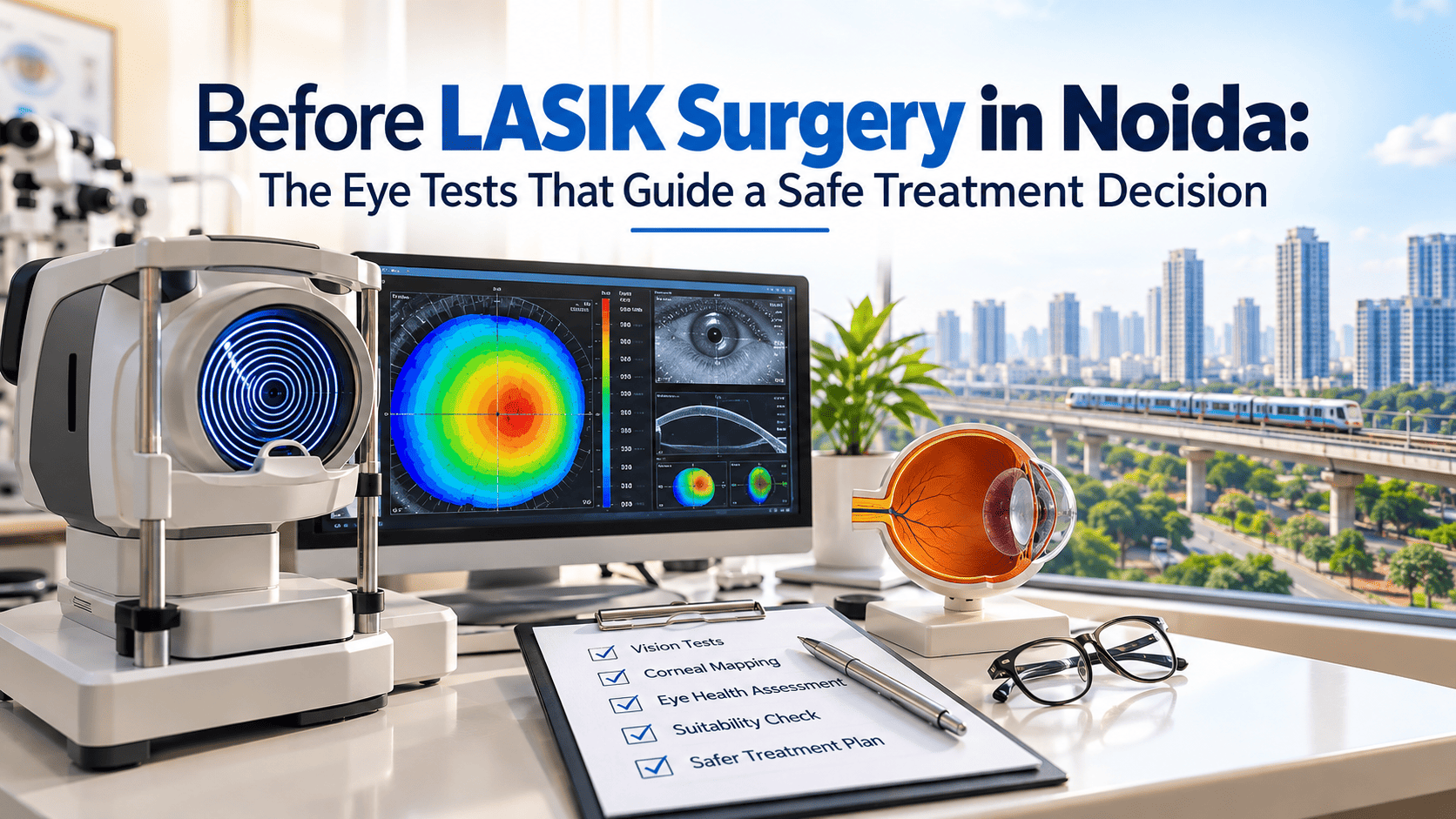
Considering LASIK surgery in Noida often starts with a practical question: can I reduce my dependence on glasses? The more important clinical question comes first: are my eyes suitable for surgery, and if so, which approach makes sense for my prescription, cornea and daily life? A detailed refractive-surgery assessment helps answer that question before any treatment is planned.
Patients looking for an eye hospital in Noida or an experienced LASIK doctor in Noida may come across several technologies, including blade-free LASIK, Contoura Vision, SILK laser vision correction and implantable collamer lens (ICL) surgery. These are not interchangeable options. Each has specific indications, limitations and risks. This guide focuses on the tests and conversations that help patients understand those differences, rather than ranking treatments or making promises about vision.
Why a pre-LASIK examination matters more than a quick prescription check
A routine spectacle test measures how much optical correction makes letters clearer. Refractive surgery screening goes considerably further. Laser treatment changes the cornea, the transparent front surface of the eye. An ophthalmologist therefore needs to assess its shape, thickness, stability and surface health, alongside the condition of the rest of the eye. A person may see well with spectacles and still not be an appropriate candidate for corneal laser surgery.
A careful evaluation has two aims. It looks for patients likely to benefit from an available treatment and, equally importantly, identifies patients for whom an intervention should be postponed, modified or avoided. This distinction matters because refractive surgery is elective. Continuing to wear spectacles or contact lenses remains a legitimate option.
1. Refraction and prescription stability
The examination usually begins by checking distance and near vision and measuring short-sightedness (myopia), long-sightedness (hyperopia) and astigmatism. The ophthalmologist may compare your current measurements with older spectacle prescriptions. Significant recent changes can indicate that eye power is not yet stable. For younger patients, eye power may continue changing into early adulthood. Treating a moving target increases the possibility that a person will need corrective lenses again.
Bring recent prescriptions, dates of any eye tests and your contact-lens details. If you have noticed rapidly changing vision, frequent headaches or inconsistent results between tests, mention these rather than assuming laser treatment will solve them.
2. Corneal topography and tomography: checking the shape of the eye
Corneal mapping creates detailed measurements of the surface and, where tomography is used, the front and back of the cornea. These measurements can identify unusual curvature patterns, asymmetry or signs that warrant investigation for conditions such as keratoconus. Such findings may change or rule out a proposed laser procedure because removing corneal tissue from an unsuitable cornea can create serious problems.
This is why a single spectacle-power number cannot determine eligibility for Contoura Vision in Noida, blade-free LASIK or another corneal procedure. A customised treatment profile does not remove the need for a healthy, structurally suitable cornea.
3. Pachymetry: understanding corneal thickness
Pachymetry measures corneal thickness. In corneal laser surgery, a calculated amount of tissue is altered to correct the prescription. The surgeon must consider the original thickness and the tissue expected to remain afterwards. A cornea that is thin for a proposed treatment may make that treatment unsuitable, even when the spectacle prescription appears relatively straightforward.
There is no useful universal thickness threshold that patients can safely apply to themselves. Decisions depend on multiple measurements, treatment parameters and the overall corneal findings. Ask the surgeon to explain what your measurements mean in your individual case.
4. Dry-eye and ocular-surface assessment
Dry eye can cause fluctuating vision, burning, watering, a gritty sensation and discomfort during screen use. Importantly, a person can have ocular-surface disease without obvious symptoms. Tear-film irregularity can also affect the accuracy of corneal measurements. LASIK may worsen dryness for some patients, particularly around the recovery period.
Your ophthalmologist may assess tear stability, eyelid margins, meibomian glands and the corneal surface. When inflammation or dry eye is detected, managing it before repeating measurements may be more appropriate than moving directly to surgery. Patients who wear contact lenses should mention any recurring redness, intolerance or dryness.
5. Pupil assessment and night-vision concerns
If you drive after dark, concerns about halos, starbursts or glare deserve specific discussion. The preoperative consultation may review pupil characteristics, prescription, corneal findings and your night-driving demands. Some patients notice new or persistent visual symptoms after refractive surgery. A clinician should discuss these possibilities without assuring you that any technique eliminates them.
Mention if your work involves night shifts, long highway drives, precision visual tasks or frequently changing lighting. Such details help make the consent conversation relevant to real-life expectations.
6. Eye pressure, dilated retinal examination and general eye health
Good vision correction begins with a healthy eye, not only a suitable cornea. Depending on clinical findings, an ophthalmologist may assess intraocular pressure, the lens, optic nerve and retina. Dilating drops may be used to examine the back of the eye, particularly when a patient has high myopia or retinal symptoms. A retinal concern requires assessment on its own merits; laser vision correction does not treat retinal disease.
Tell the doctor about previous eye surgery, inflammation, eye injuries, family eye disease, diabetes, medicines and other relevant medical conditions. Pregnancy and breastfeeding can be associated with changes affecting refractive measurements, so timing may need reconsideration. Some issues require treatment first; others may influence whether surgery is advised at all.
7. Contact-lens history and preparing for accurate measurements
Contact lenses can temporarily change corneal shape. A clinic may therefore ask you to stop wearing them for a specified period before definitive measurements. The interval differs by lens type, duration of wear and the clinician’s findings; do not assume the same break applies to soft lenses and rigid lenses. Follow the treating team’s instructions rather than relying on a generic number of days.
On the day of the examination, bring your glasses, the names of any eye drops and a list of medical issues or previous procedures. Ask whether your eyes will be dilated and whether that may temporarily blur near vision or affect driving. Allow enough time for the assessment and discussion, instead of planning surgery based on a brief screening alone.
What happens if you are not suitable for conventional LASIK?
An unsuitable LASIK assessment should not be interpreted as a failed consultation. It provides information that can prevent avoidable harm. The ophthalmologist may recommend treating dry eye, observing prescription stability, repeating scans or discussing another treatment. For some people the appropriate recommendation is no elective surgery.
Blade-free LASIK and Contoura Vision
In blade-free or femtosecond-assisted LASIK, a laser is used to create a corneal flap, followed by laser reshaping. Contoura Vision is a topography-guided form of excimer-laser treatment intended to use corneal mapping information for planning. Whether a blade-free LASIK or Contoura-based approach is suitable depends on clinical measurements, not simply on technology preference. ICARE describes its Contoura/FemtoContoura options here: https://www.icarelasik.com/contoura-and-femtocontoura/.
SILK laser vision correction
SILK is a lenticule-extraction technique. Rather than forming the conventional LASIK flap, the procedure uses laser-created tissue within the cornea that is removed through a small incision. It may be discussed with eligible patients seeking correction of certain refractive errors. However, “flapless” does not mean risk-free or suitable for everybody. Screening still assesses corneal shape, thickness, dryness, prescription and treatment range. The hospital’s SILK information is available at https://www.icarelasik.com/silk-elita/.
Surface ablation, including PRK
Photorefractive keratectomy (PRK) reshapes the cornea without creating a LASIK flap. It may be considered in selected circumstances, although it typically involves more early surface discomfort and a different recovery course from LASIK. Healing and visual stabilisation vary. The reason to discuss PRK is a clinical indication, not the assumption that it is automatically preferable for thin corneas. ICARE explains its surface-ablation service at https://www.icarelasik.com/prk-and-robotic/.
ICL surgery: an option that does not reshape the cornea
Implantable collamer lens surgery places a corrective lens inside the eye while leaving the natural crystalline lens in place. It is fundamentally different from corneal laser treatment and carries its own surgical considerations. Suitability may depend on the prescription, anterior-chamber anatomy, endothelial-cell health, lens status and other examination findings. A person who cannot undergo LASIK is not automatically eligible for ICL. Read the hospital’s ICL service information at https://www.icarelasik.com/icl/.
How an eye doctor in Noida helps connect test results with your lifestyle
Two patients with similar spectacles can receive different recommendations. One might have stable measurements, a regular cornea and healthy tear film; another might have a comparable prescription but irregular mapping or persistent dry eye. The right plan reflects these distinctions. It also considers the patient’s visual priorities: computer work, sports, travel, caregiving, night driving and the possibility of wearing reading glasses with age.
A refractive consultation should provide space for questions. Ask the clinician to show you the major findings, describe reasonable alternatives and explain what would make the treatment less predictable. Ask what recovery feels like, when work and exercise might resume, how follow-up is arranged and which symptoms require urgent advice. This discussion is part of informed consent, not an optional extra.
Questions worth asking before deciding on vision correction
- What did my corneal maps and thickness results show, and are any findings borderline?
- Are my recent prescriptions stable enough for surgery?
- Do I have dry eye, allergy or another condition that needs treatment first?
- Why is this procedure being considered instead of other available options?
- What side effects and uncommon but important complications should I understand?
- What is the expected follow-up schedule, and whom should I contact urgently?
- Could I still need glasses for driving, reading or other activities?
Patients researching WaveLight Plus InnovEyes can review ICARE’s description of the technology at https://www.icarelasik.com/wavelight-plus-innoveyes/. As with other platforms, a feature description is not a substitute for individual clinical suitability.
Recovery planning begins before the procedure
While each approach has a different recovery pathway, there are practical questions common to refractive surgery. Patients should discuss transport home, the eye-drop schedule, time away from work, expected discomfort, eye protection, hygiene and follow-up appointments. Do not restart contact lenses, rub the eyes, swim or resume sports against the instructions of your treating surgeon.
Temporary blur, light sensitivity, dryness or fluctuating vision may occur after certain treatments, but the intensity and duration vary. Increasing pain, a marked decline in vision, significant redness or new concerning symptoms should prompt urgent contact with the treating eye-care team. Do not wait for a routine follow-up if something feels seriously wrong.
Choosing an eye hospital near me: why accessibility matters after assessment
When someone searches “eye hospital near me” or “LASIK hospital near me”, convenience is understandable. However, a refractive-surgery decision should also consider appropriate specialist assessment, explanation of choices and access to aftercare. The ability to return for scheduled reviews can matter, particularly if healing takes longer than anticipated.
ICARE Eye Hospital lists a Sector 26, Noida centre and a Greater Noida West centre. For the latest clinic availability, exact appointment location and whether a particular procedure is offered at your chosen centre, confirm directly with the hospital. Details are published at https://www.icarelasik.com/contact-us/. Patients searching for a “Contoura hospital near me” should likewise verify both the consultation location and treatment availability rather than assuming every listed branch provides the same procedure.
A practical timeline: from first visit to a treatment decision
Before the first consultation
Collect your prescriptions, record visual symptoms and make a note of contact-lens use. If you have an eye problem, prioritise diagnosing it over scheduling elective surgery. Prepare two or three questions about the activities you most want to perform with less reliance on glasses.
During the assessment
Expect more than one measurement. Some tests may be repeated when the tear film is unstable or results do not agree. If the doctor recommends treating the ocular surface or returning after a period of observation, this is part of careful planning rather than an unnecessary delay.
After receiving a recommendation
Review the anticipated benefit and limitations in ordinary terms: what improvement is realistic, what glasses might still be needed and what follow-up involves. Consider taking time to reflect on the choice. Refractive surgery is not an emergency. Consent should be based on understanding rather than pressure.
Frequently Asked Questions
1. Can a LASIK doctor decide suitability using only my glasses number?
No. A glasses prescription is only one part of assessment. Corneal mapping, thickness, ocular-surface health, prescription stability and general eye health also matter.
2. Why might my LASIK scans need to be repeated?
Repeat measurements may be needed when contact-lens wear, dry eye or inconsistent results make the initial measurements unreliable. The treating team determines the timing.
3. Can someone with dry eyes undergo LASIK surgery?
It depends on severity and clinical findings. Dry eye may need treatment before a final decision, and some patients may be advised against LASIK.
4. Does a thin cornea always rule out every type of vision correction?
No, but it can exclude certain corneal laser approaches. Alternative procedures have different eligibility criteria and their own risks.
5. Is Contoura Vision appropriate for every patient with astigmatism?
No. Corneal mapping and other eligibility criteria are essential. The surgeon determines whether a topography-guided plan is indicated.
6. Is SILK laser surgery completely free of dry-eye or visual side effects?
No surgical technique can be described as free of risk. Discuss dryness, visual symptoms and other possible complications with your surgeon.
7. Is blade-free LASIK the same as flapless laser surgery?
No. Femtosecond-assisted LASIK typically creates a flap using a laser. Lenticule procedures such as SILK use a different, flapless method.
8. Can I have ICL surgery if LASIK is unsuitable?
Possibly, but not automatically. ICL requires a separate evaluation of eye anatomy, prescription and overall ocular health.
9. Will I never need spectacles after refractive surgery?
Not necessarily. Some patients still require glasses for particular tasks, and age-related near-vision changes can occur later.
10. Where can I arrange a refractive-surgery assessment in Noida?
ICARE Eye Hospital provides refractive-surgery consultation information through its official website and contact page. Confirm appointments and the relevant centre directly before visiting.
Appointments and contact information: ICARE Eye Hospital, Noida
ICARE Eye Hospital & Post Graduate Institute lists refractive-surgery services and a clinical team that includes Dr. Ambarish P. Toshniwal, Head of Department and Senior Consultant in Refractive Services. Appointment suitability and doctor availability should be confirmed with the hospital.
Sector 26 centre: E3A, Sector 26, Noida, Uttar Pradesh 201301. Telephone: +91 9910430391 or 0120 3586611. Greater Noida West centre: Sector 04, Gaur City 1, opposite City Plaza, Greater Noida West, Uttar Pradesh 201318. Telephone: +91 8700034646 or 0120 3550000. Email: lasik@icarehospital.org. Website: https://www.icarelasik.com/. Appointment and centre details: https://www.icarelasik.com/contact-us/.
Conclusion: an informed assessment comes before a procedure
For people considering LASIK surgery in Noida, the most useful first step is not selecting a laser by name. It is understanding whether the eye is healthy, the measurements are reliable and the expected outcome aligns with everyday needs. Corneal mapping, tear-film assessment, prescription stability and a complete clinical review help identify whether LASIK, Contoura Vision, SILK, PRK, ICL or continued spectacle use warrants consideration. A qualified ophthalmologist can explain the findings and help you make an informed decision without assuming that surgery is right for everyone.