
 LASIKSelf Test!
 Call Now9910430391
 BookAppointment
Looking for the Best LASIK Hospital in Noida? Start With the Right Question
Searching for the best LASIK hospital in Noida can produce a long list of hospitals, eye centres, procedures and laser technologies. But choosing refractive surgery is not simply a matter of finding the newest laser or the most attractive package.
The more important question is:
Which refractive surgery centre can accurately evaluate my eyes and recommend the procedure that is appropriate for me?
That distinction matters because LASIK is not a one-size-fits-all procedure.
A patient may have the same spectacle prescription as someone else but have a different corneal thickness, corneal shape, ocular-surface condition, pupil characteristics or visual requirement. These differences can influence whether LASIK is appropriate and which refractive procedure should be considered.
For patients searching for an Eye Hospital in Noida, a LASIK Doctor in Noida, or a LASIK Hospital Near Me, the quality of the evaluation is therefore just as important as the laser technology.
At ICARE Eye Hospital & Post Graduate Institute, Sector 26, Noida, refractive surgery is part of a broader ophthalmic practice. The hospital’s current website lists LASIK services and multiple refractive options, while its Sector 26 centre lists Dr. Ambarish P. Toshniwal as Head of Department & Senior Consultant, Refractive Services. (ICARE)
What Should You Look for in the Best LASIK Hospital in Noida?
Before choosing a hospital for laser vision correction, patients should consider five important areas.
1. Comprehensive Pre-LASIK Evaluation
A refractive surgery consultation should go beyond simply checking your spectacle number.
The FDA recommends evaluating factors such as:
- Stability of your prescription
- Corneal thickness
- Dry eye
- Pupil size
- Existing eye conditions
- Medical conditions and medications
- Previous eye surgery or injury
This is why an experienced LASIK Doctor in Noida should first determine whether you are actually a suitable candidate before discussing a particular procedure.
2. Access to More Than One Refractive Procedure
A strong refractive surgery programme should not be built around the idea that one procedure is appropriate for every patient.
Depending on the examination, patients may be considered for different forms of laser or lens-based vision correction.
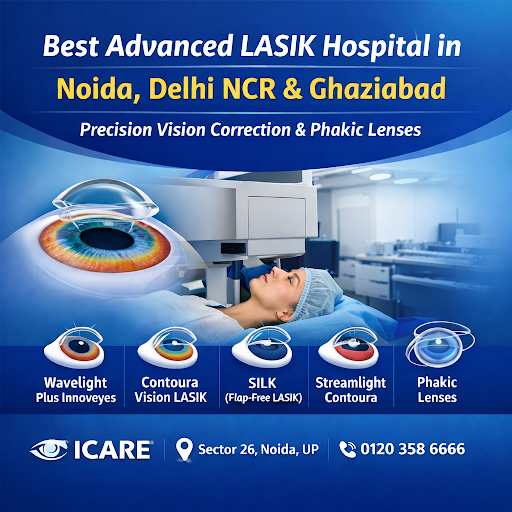
The current ICARE refractive-surgery content describes options including:
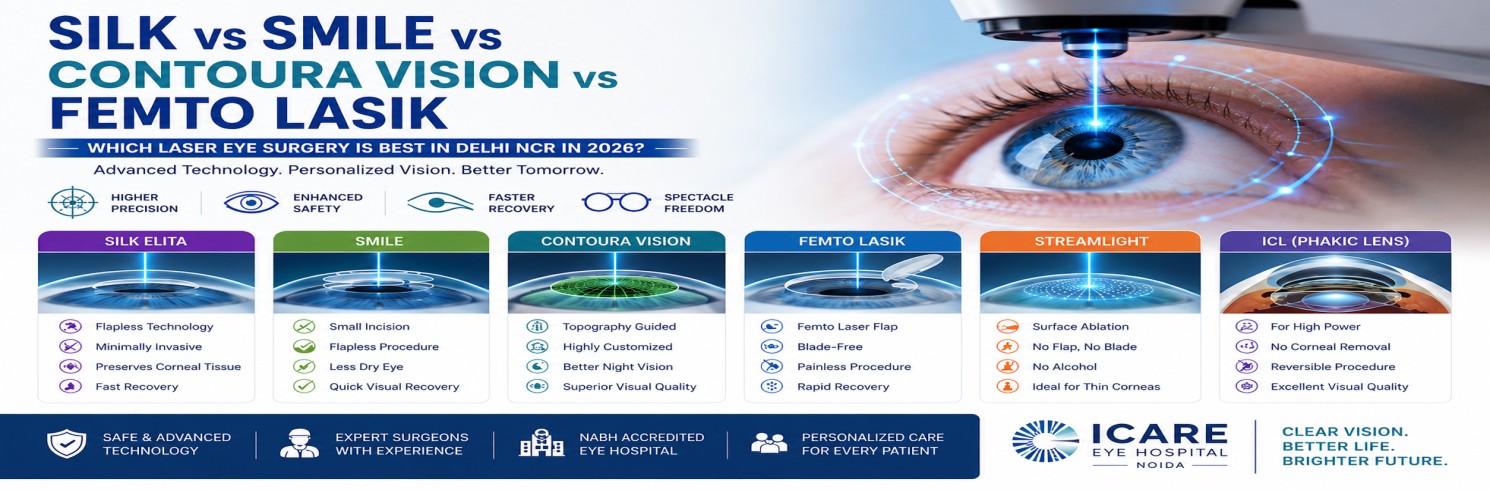
- WaveLight Plus InnovEyes®
- SILK Laser Vision Correction
- Femto LASIK
- PRK
- Contoura-related procedures
- Implantable Collamer Lens (ICL) / phakic lens surgery
The appropriate option depends on the patient’s anatomy, refractive error, ocular-surface status, lifestyle and visual requirements. (ICARE)
This is particularly important for patients searching for SILK Laser Surgery in Noida, ICL Surgery in Noida, or Contoura Vision in Noida. The search term should not determine the treatment; the eye examination should.
3. An Experienced Refractive Surgery Team
The surgeon performing or supervising refractive surgery should have appropriate ophthalmic training and experience in the relevant procedures.
ICARE’s current doctor profile identifies Dr. Ambarish P. Toshniwal as:
Head of Department & Senior Consultant, Refractive Services
Qualifications: MBBS, DNB (Sankara Nethralaya), FRCS (UK), PGDHHM.
His listed areas of expertise include Refractive Surgery (LASIK, SMILE, PRK), Cornea and Ocular Surface Disorders, Cataract Surgery and Medical Retina. The profile states that he has over two decades of ophthalmology experience and has worked at institutions in India and abroad. (ICARE)
This provides patients with a verified professional profile when researching a LASIK Doctor in Noida.
4. The Hospital Should Be Able to Say “No” When Surgery Is Not Appropriate
This is an often-overlooked part of choosing a refractive surgery centre.
LASIK is elective surgery. A patient should not be encouraged to proceed simply because they want to stop wearing glasses.
The FDA identifies several factors that can make a patient a poor or unsuitable candidate, including unstable refraction, thin corneas, dry eye, certain medical conditions, some eye diseases and certain occupational considerations. (U.S. Food and Drug Administration)
A responsible refractive-surgery consultation therefore includes discussion of:
- Benefits
- Risks
- Alternatives
- Limitations
- Expected recovery
- Possibility of residual refractive error
- Future age-related changes
5. Comprehensive Eye Care Beyond LASIK
LASIK is only one area of ophthalmology.
A patient looking for an Eye Hospital in Noida may eventually need care for cataract, glaucoma, retina, cornea, pediatric eye disease or other conditions.
ICARE’s Sector 26 centre currently lists multiple ophthalmic specialties and consultants, including refractive services, cornea, retina, glaucoma, pediatric ophthalmology, cataract and anterior-segment services. (ICARE)
That broader ophthalmic environment can be valuable for patients who want access to comprehensive eye care rather than a centre focused exclusively on refractive surgery.
LASIK Is Not Simply About Removing Spectacle Power
The objective of refractive surgery is to reduce dependence on spectacles or contact lenses, but visual quality and patient expectations are also important.
The FDA notes that refractive surgery can have limitations and that some patients may experience visual symptoms such as glare, halos, starbursts, dry eye or changes in contrast sensitivity. Some patients may still require glasses or contact lenses after surgery. (U.S. Food and Drug Administration)
This is why a good consultation should discuss what the patient actually wants from surgery.
For example:
A frequent night driver
Night-time visual requirements may be an important part of treatment planning.
An athlete
The patient may want to understand whether a flap-based or flap-free option is appropriate.
A defence aspirant
The patient should discuss the applicable recruitment and medical standards before choosing a procedure.
A software professional
Ocular-surface health and visual comfort may be particularly relevant.
A patient with high refractive error
A corneal laser procedure may not necessarily be the best option; lens-based correction may need consideration.
Understanding the Main Refractive Surgery Options at ICARE
WaveLight Plus InnovEyes®
ICARE’s current refractive content describes WaveLight Plus InnovEyes® as a personalized laser vision correction approach using detailed ocular measurements to create an individualized treatment profile. (ICARE)
The important point for patients is that customized treatment does not mean that every patient should automatically receive the same customized procedure.
The suitability of a treatment should be established through clinical evaluation.
SILK Laser Vision Correction
SILK is a flap-free lenticule-based refractive procedure.
ICARE’s published refractive material describes SILK as a minimally invasive, flap-free approach that creates a planned lenticule within the cornea through a small incision. (ICARE)
Patients searching for SILK Laser Surgery in Noida should understand that the absence of a flap does not mean that the procedure is automatically appropriate for every patient.
A complete examination remains essential.
Femto LASIK
Femto LASIK uses a femtosecond laser to create the corneal flap before the excimer laser reshapes the cornea.
It is an established form of laser vision correction, but candidacy still depends on factors such as corneal structure, refractive stability and ocular health.
The FDA recommends a detailed baseline evaluation before LASIK and emphasizes discussion of risks, benefits and alternatives with the treating doctor. (U.S. Food and Drug Administration)
PRK
PRK is a surface-based laser vision correction procedure.
It may be considered in patients for whom a flap-based procedure is not appropriate, depending on the clinical findings.
The recovery profile differs from LASIK, so patients should discuss expected recovery and postoperative care before deciding on the procedure.
ICL / Phakic Lens Surgery
Not every patient with high spectacle power is suitable for corneal laser surgery.
In selected patients, an intraocular refractive procedure such as an Implantable Collamer Lens may be considered.
The American Academy of Ophthalmology’s EyeWiki notes that intraocular refractive procedures may be considered in patients who are not candidates for corneal procedures because of factors such as dry eye, thin corneal tissue or very high refractive error.
ICARE’s current refractive content also lists ICL / phakic lens surgery among its vision-correction options. (ICARE)
What Makes a Good LASIK Consultation Different?
A consultation should not begin and end with:
“What is your spectacle number?”
A meaningful refractive evaluation considers the entire eye.
The doctor may need to understand:
- Current spectacle prescription
- Previous prescription changes
- Contact lens history
- Dry-eye symptoms
- Previous eye disease
- Previous eye surgery
- Medical history
- Medications
- Occupational requirements
- Sports participation
- Visual expectations
The FDA recommends that patients disclose their medical and eye history and medications and discuss candidacy, risks, benefits, alternatives and postoperative expectations before consenting to surgery.
Why “LASIK Hospital Near Me” Should Not Mean “Nearest Hospital”
Searches such as “LASIK Hospital Near Me” and “Eye Hospital Near Me” are increasingly common because patients want convenient access to healthcare.
But proximity should not be the only selection criterion.
For elective refractive surgery, consider:
Location + Clinical Expertise + Diagnostics + Procedure Options + Follow-up Care
A hospital that is ten minutes closer is not necessarily the better choice if the patient has not received an adequate refractive evaluation.
For patients in Delhi NCR, ICARE Eye Hospital’s Sector 26, Noida location provides access to a dedicated eye hospital while remaining accessible from Delhi, Ghaziabad, Greater Noida and surrounding NCR areas.
ICARE Eye Hospital, Sector 26, Noida
ICARE Eye Hospital & Post Graduate Institute
Address:
E3A, ICARE Eye Hospital Road, Block E, Sector 26, Noida, Uttar Pradesh – 201301
Hospital Phone:
0120 358 6666 / 600 / 601 / 602
LASIK Emergency:
+91 8076289115
The hospital’s current website lists its Sector 26 branch, refractive services and appointment contact details. (ICARE)
Official website:
https://www.icarehospital.org/
LASIK information:
https://www.icarehospital.org/lasik/
Refractive surgery doctors:
https://www.icarehospital.org/doctor/
Why ICARE Can Be Relevant for Patients Searching “Eye Hospital Near Me”
A local search is often the beginning of a healthcare decision, not the end of it.
Someone searching:
Eye Hospital Near Me
may initially be looking for a convenient consultation.
Someone searching:
LASIK Hospital Near Me
is more likely to be researching a specific treatment.
And someone searching:
LASIK Doctor in Noida
is already moving closer to a doctor-selection decision.
For this reason, the information on the website needs to answer all three levels of intent:
Discovery
Where is the hospital?
Evaluation
Which services and doctors are available?
Decision
Is this the appropriate place for my particular eye condition?
A well-structured website should answer these questions without making exaggerated claims.
The Most Important Question: Which Procedure Is Right for You?
There is no universally “best” LASIK procedure.
The correct question is:
Which vision-correction procedure is most appropriate for my eyes?
The answer can only be established after a proper ophthalmic evaluation.
For one patient, a laser procedure may be appropriate.
For another, a flap-free procedure may be considered.
For someone with high refractive error or unsuitable corneal characteristics, an ICL may be discussed.
And for another patient, the safest decision may be not to undergo refractive surgery at all.
That is why choosing the right LASIK Hospital in Noida begins with choosing the right evaluation—not simply the right machine.
What This Means for Patients
If you are considering LASIK in Noida or Delhi NCR, do not choose a hospital solely because it advertises:
- The newest laser
- The lowest price
- Guaranteed vision
- “100% safe” surgery
- A particular technology as universally superior
Instead, ask:
- Will my eyes receive a comprehensive evaluation?
- Is my spectacle power stable?
- Is my cornea suitable?
- Do I have dry eye or another ocular-surface problem?
- What procedures are appropriate for me?
- What are the alternatives?
- What are the potential risks?
- What should I expect during recovery?
- What follow-up will I receive?
- What happens if I am not a suitable candidate?
These questions are much more valuable than simply asking which laser is newest.
A Better Way to Search for the Best LASIK Hospital in Noida
If you are researching LASIK online, combine your search with specific questions.
Instead of searching only:
“Best LASIK Hospital in Noida”
also research:
- LASIK Doctor in Noida
- LASIK Hospital in Noida
- Blade Free LASIK Surgery in Noida
- SILK Laser Surgery in Noida
- ICL Surgery in Noida
- Eye Hospital in Noida
- Eye Hospital Near Me
- LASIK Hospital Near Me
- Contoura Vision in Noida
This gives patients a clearer picture of the available treatment pathways and helps them compare hospitals based on clinical relevance rather than advertising alone.
Frequently Asked Questions About LASIK in Noida
1. Which is the best LASIK hospital in Noida?
The best LASIK hospital for an individual patient should be selected based on comprehensive eye evaluation, refractive-surgery expertise, appropriate technology, patient selection, and postoperative care rather than a single technology or promotional claim. ICARE Eye Hospital & Post Graduate Institute in Sector 26, Noida provides refractive surgery evaluation and multiple vision-correction options. (icarehospital.org)
2. How do I choose a LASIK doctor in Noida?
Look for an ophthalmologist with specific training and experience in refractive surgery and ask about the diagnostic evaluation, available procedures, potential alternatives, risks and follow-up. ICARE’s current website lists Dr. Ambarish P. Toshniwal as Head of Department & Senior Consultant, Refractive Services. (icarehospital.org)
3. Is LASIK suitable for everyone with spectacles?
No. LASIK candidacy depends on factors including refractive stability, corneal characteristics, ocular-surface health and overall eye health. Some patients may be better suited to another procedure or may be advised against refractive surgery.
4. What is the difference between LASIK and SILK?
LASIK involves creation of a corneal flap followed by laser reshaping of the cornea. SILK is a flap-free lenticule-based procedure. The appropriate procedure depends on the patient’s clinical findings and should be determined after a refractive evaluation.
5. What is blade-free LASIK surgery?
Blade-free LASIK, commonly referred to as Femto LASIK, uses a femtosecond laser to create the corneal flap rather than a mechanical blade. It is one of the established approaches to laser vision correction for appropriately selected patients.
6. Is SILK Laser Surgery available in Noida?
ICARE’s current refractive-surgery information lists SILK Laser Vision Correction among its treatment options. Patients should undergo an examination to determine whether they are suitable candidates. (icarehospital.org)
7. What is ICL surgery and who may need it?
ICL, or Implantable Collamer Lens surgery, is a lens-based refractive procedure. It may be considered for selected patients for whom corneal laser procedures are unsuitable, including some patients with high refractive errors or particular corneal characteristics.
ICARE’s current refractive content lists ICL/phakic lens surgery among its vision-correction options. (icarehospital.org)
8. What is Contoura Vision?
Contoura is a topography-guided approach to laser vision correction. The FDA describes topography-guided LASIK as a form of LASIK in which corneal topography is used to guide treatment planning. (fda.gov)
Patients searching for Contoura Vision in Noida should still undergo individual assessment rather than assuming that a particular technology is appropriate for them.
9. How long does LASIK recovery take?
Recovery varies according to the procedure and individual patient. Many patients experience useful visual improvement relatively quickly after LASIK, but the eye continues to heal and visual quality can fluctuate during the recovery period. Your surgeon should provide procedure-specific instructions and follow-up.
10. Is LASIK permanent?
LASIK changes the shape of the cornea to correct the existing refractive error. It does not stop natural changes in the eye that can occur later in life. For example, presbyopia can develop with age, and cataracts can occur independently of previous LASIK.
11. Can someone with high spectacle power have LASIK?
Some patients with higher refractive errors may be candidates for laser vision correction, while others may be better suited to a lens-based procedure such as ICL. Corneal thickness, corneal shape and other clinical factors must be evaluated before a recommendation is made.
12. Can I undergo LASIK if I have dry eyes?
Dry eye is an important consideration before refractive surgery. The FDA specifically identifies dry eye as a factor that should be assessed before LASIK. Patients with significant ocular-surface problems may require treatment or further evaluation before surgery. (fda.gov)
13. Is LASIK painful?
Numbing eye drops are used during LASIK. Patients may experience sensations such as pressure or discomfort around the procedure, and temporary irritation or watering can occur afterward. Your surgeon should explain what to expect before surgery.
14. Can I drive after LASIK?
You should not assume that you can drive immediately after surgery. Driving should resume only when your ophthalmologist confirms that your vision is adequate and you are medically fit to drive.
15. Where can I get a LASIK consultation near Delhi NCR?
Patients from Delhi NCR can seek a refractive-surgery consultation at ICARE Eye Hospital & Post Graduate Institute in Sector 26, Noida.
Address:
E3A, ICARE Eye Hospital Road, Block E, Sector 26, Noida, Uttar Pradesh 201301
Phone: 0120 358 6666
Website: ICARE Eye Hospital
Best LASIK Hospital in Noida: What Patients Should Compare Before Making a Decision
Searching for the best LASIK hospital in Noida should ultimately lead to a clinical comparison, not just a Google ranking.
Before scheduling surgery, patients can ask the hospital:
Does the centre perform a comprehensive refractive evaluation?
A spectacle-power check alone is not enough to establish LASIK suitability.
Does the centre offer different refractive procedures?
Access to multiple options can allow the ophthalmologist to consider alternatives when conventional LASIK is not appropriate.
Is the surgeon experienced specifically in refractive surgery?
Patients should review the surgeon’s qualifications, specialty and experience.
Are risks and alternatives discussed?
A proper informed-consent discussion should include potential benefits, limitations, risks and alternatives.
Is postoperative follow-up available?
Follow-up is an integral part of refractive surgery rather than an optional add-on.
Best Eye Hospital in Noida and Delhi: Why Location and Clinical Expertise Both Matter
Patients frequently begin their search with terms such as “Eye Hospital Near Me” or “LASIK Hospital Near Me.”
For local SEO, these searches are particularly important because the patient’s location often determines which hospital they consider.
However, proximity should not be the only criterion.
A patient from Delhi may find that a specialist eye hospital in Sector 26, Noida is a practical option depending on their location and transport access.
ICARE’s Sector 26 location is:
E3A, ICARE Eye Hospital Road, Block E, Sector 26, Noida, Uttar Pradesh 201301.
This makes the hospital accessible to patients across Noida and neighbouring Delhi NCR areas.
For Google Maps and local discovery, patients should use the hospital’s verified Google Business Profile rather than relying on third-party listings, as business information can change.
Serving Noida, Greater Noida, Ghaziabad and Delhi NCR
A strong local ophthalmology website should answer the questions patients actually ask in their region.
For refractive surgery, this includes searches such as:
- Best LASIK Hospital in Noida
- LASIK Hospital in Noida
- LASIK Doctor in Noida
- Blade Free LASIK Surgery in Noida
- SILK Laser Surgery in Noida
- ICL Surgery in Noida
- Best Eye Hospital in Noida
- Eye Doctors in Noida
- Eye Hospital Near Me
- LASIK Hospital Near Me
ICARE can use these local search themes to build useful service and location content without creating repetitive doorway pages.
The goal should be to provide genuinely different information for each location or service page rather than changing only the city name.
Delhi Patients Looking for LASIK in Noida
Patients living in Delhi have access to a large number of ophthalmology providers. For an elective procedure such as refractive surgery, the decision should be based on clinical suitability and the quality of the overall care pathway.
A patient travelling from Delhi to Noida for a LASIK consultation should consider:
- Ease of reaching the hospital
- Availability of the required diagnostic evaluation
- Refractive surgeon expertise
- Available procedures
- Follow-up arrangements
- Emergency contact arrangements
- Overall continuity of care
This is more meaningful than choosing a hospital solely because it appears first for a particular search query.
What About “Eye Hospital Near Me”?
“Eye Hospital Near Me” is a broad local-intent search.
Someone using this phrase may be looking for:
- Eye examination
- Red-eye consultation
- Cataract evaluation
- LASIK consultation
- Retina consultation
- Glaucoma evaluation
- Pediatric eye care
- Emergency ophthalmology
Therefore, ICARE’s website should make it easy for visitors to immediately identify:
Where the hospital is located → What services are available → Which doctors provide them → How to contact the hospital → How to book an appointment.
This structure helps both users and search engines understand the relationship between the hospital, doctors, services and location.
What About “LASIK Hospital Near Me”?
For someone searching LASIK Hospital Near Me, the ideal next step is not simply to book the cheapest available procedure.
The patient should first arrange a refractive evaluation.
A good consultation should help answer:
- Am I suitable for LASIK?
- What is my corneal thickness?
- Is my prescription stable?
- Do I have dry eye?
- Which procedure is appropriate?
- What alternatives are available?
- What recovery should I expect?
- What are the possible risks?
Only after these questions have been addressed should a patient decide whether to proceed.
ICARE Eye Hospital: Refractive Surgery in Sector 26, Noida
ICARE Eye Hospital & Post Graduate Institute provides comprehensive ophthalmic care and refractive surgery services from its Sector 26, Noida centre.
The current ICARE website provides information about its refractive services and doctors, including Dr. Ambarish P. Toshniwal, Head of Department & Senior Consultant, Refractive Services. (icarehospital.org)
For patients considering LASIK, SILK, PRK, Femto LASIK, topography-guided treatment or ICL, the appropriate procedure should be determined following a detailed examination.
Your Next Step Should Be a Refractive Evaluation
If you are researching the Best LASIK Hospital in Noida, do not make the decision based on a keyword, advertisement or technology name alone.
Begin with a comprehensive consultation.
A qualified refractive surgeon can assess your eyes, explain the available options and help determine whether laser vision correction is appropriate for you.
Schedule a consultation at:
ICARE Eye Hospital & Post Graduate Institute
E3A, ICARE Eye Hospital Road, Block E, Sector 26, Noida, Uttar Pradesh 201301
Phone: 0120 358 6666
Visit the official ICARE Eye Hospital website
Final Takeaway
There is no single laser procedure that is best for every patient.
The best refractive surgery decision starts with an accurate examination, an experienced ophthalmologist, appropriate technology and realistic expectations.
For patients searching for the Best LASIK Hospital in Noida, LASIK Doctor in Noida, LASIK Hospital Near Me, SILK Laser Surgery in Noida, ICL Surgery in Noida, or an Eye Hospital Near Me, ICARE Eye Hospital & Post Graduate Institute in Sector 26 provides a comprehensive setting for evaluation and ophthalmic care.