

 LASIKSelf Test!
 Call Now9910430391
 BookAppointment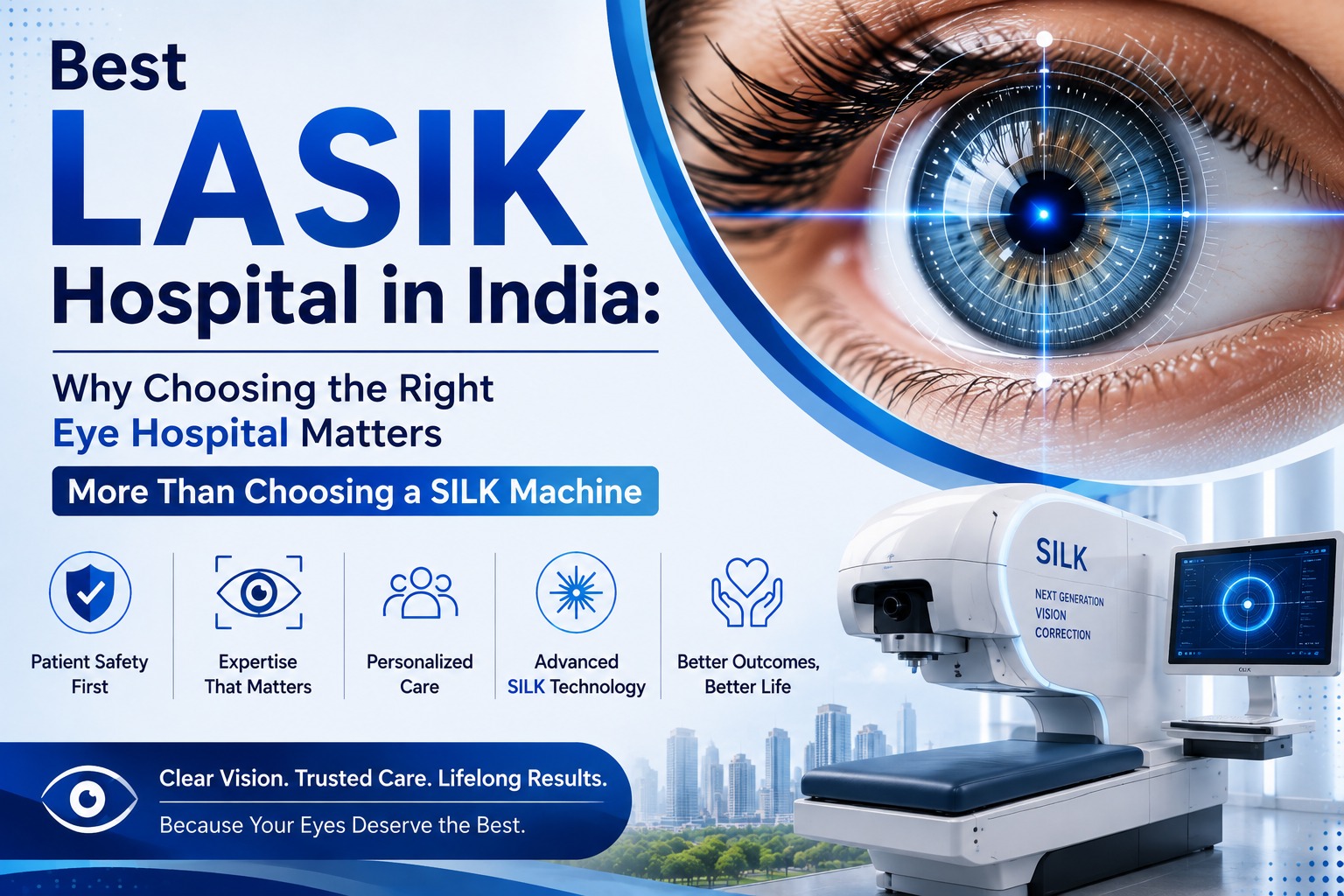
A Comprehensive Guide to Advanced Refractive Surgery, WaveLight Plus InnovEyes®, SILK Laser Vision Correction and Personalized Spectacle Removal at ICARE Eye Hospital, Noida
For more than two decades, laser vision correction has transformed millions of lives by helping people reduce or eliminate their dependence on spectacles and contact lenses. Yet despite remarkable technological advancements, one misconception continues to influence how patients choose a hospital.
Most people believe that the best LASIK hospital in India is simply the one that owns the newest laser machine.
Modern refractive surgery tells a very different story.
The quality of vision achieved after laser eye surgery is no longer determined by laser speed alone. It depends on a combination of advanced diagnostics, meticulous patient selection, individualized treatment planning, surgeon expertise, ocular surface optimisation, corneal biomechanics, postoperative care and the ability to recommend the most appropriate procedure rather than the most heavily marketed one.
This shift represents one of the most significant developments in modern ophthalmology.
Today’s refractive surgery is no longer about performing LASIK on every patient who walks through the door. It is about understanding that every eye is structurally unique and therefore deserves a personalised treatment strategy based on scientific evaluation rather than a standard protocol.
This philosophy forms the foundation of refractive services at ICARE Eye Hospital & Post Graduate Institute, Noida.
Located in Sector 26, Noida, ICARE Eye Hospital has developed one of North India’s comprehensive refractive surgery programmes by integrating advanced diagnostic technology, customised surgical planning, evidence-based clinical protocols and multiple vision correction options including WaveLight Plus InnovEyes®, SILK Laser Vision Correction, Femto LASIK, EPICONTOURA, STREAMLIGHT CONTOURA, and Implantable Collamer Lens (ICL) – ( PHAKIC LENSES ) surgery.
Rather than asking,
“Which laser is the latest?”
the clinical team at ICARE asks a far more important question—
“Which procedure will deliver the safest, most stable and highest quality vision for this individual patient over the next twenty to thirty years?”
That distinction separates a hospital that performs laser eye surgery from an institution dedicated to comprehensive refractive medicine.
The Evolution of Laser Vision Correction: From Spectacle Removal to Personalized Visual Performance
The conversation surrounding LASIK has changed dramatically over the last decade.
Patients are no longer satisfied with simply achieving 6/6 vision on a chart.
Today’s expectations are significantly higher.
Professionals working on multiple digital displays expect comfortable vision during prolonged screen use.
Pilots and frequent night drivers expect improved contrast sensitivity and reduced glare.
Athletes expect visual stability during high-impact activities.
Healthcare professionals demand precision during intricate clinical procedures.
Young adults preparing for defence services often seek flap-free technologies that complement their physically active lifestyles.
Meeting these expectations requires much more than correcting spectacle power.
Modern refractive surgery now focuses on improving the overall optical performance of the eye while preserving corneal integrity and maintaining long-term visual stability.
This is precisely why advanced technologies such as WaveLight Plus InnovEyes® and SILK Laser Vision Correction & STREAMLIGHT CONTOURA have become important milestones in the evolution of refractive surgery.
They represent a shift away from standardized laser treatment towards intelligent, customised vision correction.
Why the Best LASIK Hospital in India Is Defined by Clinical Decision-Making, Not Marketing
One of the greatest challenges facing patients today is the overwhelming amount of information available online.
Every hospital claims to offer the latest technology.
Every advertisement promises freedom from spectacles.
Every website highlights advanced laser systems.
However, very few explain the single factor that influences surgical success more than anything else—
Appropriate patient selection.
An experienced refractive surgeon understands that the best procedure for one patient may not be appropriate for another.
Two individuals may have the same spectacle power of -5.00 diopters.
Yet one may be an ideal candidate for WaveLight Plus InnovEyes®, while another may benefit from SILK Laser Vision Correction, and a third may achieve safer long-term results with Implantable Collamer Lens (ICL) surgery or a STREAMLIGHT CONTOURA.
The difference lies not in the spectacle number but in the anatomy and physiology of the eye.
Factors such as corneal thickness, corneal biomechanics, tear film quality, ocular surface health, pupil dynamics, higher-order aberrations, lifestyle requirements and professional visual demands all influence treatment planning.
This is why personalised refractive surgery has become the global standard of care.
Why Every Eye Requires an Individualized Refractive Surgery Plan
No two fingerprints are identical.
Similarly, no two corneas are identical.
Modern ophthalmology recognises that every eye possesses a unique optical fingerprint.
A successful refractive surgery programme therefore begins with understanding the individual eye before recommending any treatment.
At ICARE Eye Hospital, comprehensive refractive evaluation extends far beyond measuring spectacle power.
Clinical assessment focuses on understanding:
- Corneal architecture
- Corneal biomechanics
- Tear film stability
- Higher-order optical aberrations
- Ocular surface integrity
- Retinal health
- Lifestyle requirements
- Occupational visual demands
- Long-term ocular safety
Only after analysing these parameters does the refractive team determine whether a patient should undergo laser vision correction and, more importantly, which procedure is likely to provide the safest and most predictable outcome.
This patient-first philosophy ensures that technology supports clinical decision-making rather than replacing it.
Beyond Conventional LASIK: The New Era of Personalized Vision Correction
Refractive surgery has progressed far beyond the traditional concept of LASIK.
Today’s patients benefit from an expanded range of scientifically validated procedures designed for different ocular profiles.
At ICARE Eye Hospital, the objective is not to perform more surgeries.
The objective is to perform the right surgery.
This personalised approach may include:
- WaveLight Plus InnovEyes® for highly customised laser vision correction.
- SILK Laser Vision Correction for suitable candidates seeking flap-free treatment.
- Femto LASIK for patients where blade-free flap creation offers the most appropriate solution.
- PRK / STREAMLIGHT CONTOURA in carefully selected clinical situations.
- Implantable Collamer Lens (ICL) – ( PHAKIC LENSES ) for individuals with high refractive errors or corneal characteristics that make laser vision correction less suitable.
The availability of multiple treatment pathways enables refractive surgeons to recommend the procedure based on clinical science rather than technological limitation.
This approach reflects the future of refractive surgery—one where every recommendation is guided by precision diagnostics, evidence-based medicine and long-term visual quality rather than a one-size-fits-all model.
The ICARE Refractive Surgery Protocol: Why Modern Vision Correction Begins Long Before the Laser Is Activated
One of the biggest misconceptions surrounding laser eye surgery is that the procedure begins inside the laser suite.
In reality, successful refractive surgery begins days before the patient enters the operating theatre.
Every successful visual outcome is built upon one critical foundation—scientific diagnosis.
At ICARE Eye Hospital, refractive surgery is never viewed as a standalone procedure. Instead, it is considered a carefully structured clinical pathway where every decision is based on measurable ocular parameters rather than assumptions.
This philosophy has become increasingly important because modern refractive surgery is no longer about removing spectacle power alone. Today’s objective is to maximize visual quality, preserve corneal biomechanics, minimize postoperative dry eye, optimize night vision, and maintain long-term refractive stability.
Achieving these outcomes requires much more than a laser platform.
It requires understanding the eye as an integrated optical system.
That understanding begins with diagnostics.
Why Comprehensive Diagnostics Matter More Than Laser Speed
Many hospitals proudly advertise the speed of their laser.
Patients often encounter marketing claims describing procedures completed within seconds.
While treatment time is important, it contributes very little to the final visual outcome.
The most critical part of refractive surgery occurs before the first laser pulse is delivered.
At ICARE Eye Hospital, every patient undergoes a structured refractive evaluation designed to answer one question:
“What is the safest and most appropriate procedure for this eye?”
Instead of immediately recommending LASIK, surgeons first evaluate whether laser vision correction itself is appropriate.
This distinction reflects responsible refractive medicine.
The diagnostic protocol may include evaluation of:
- Corneal topography to understand surface curvature.
- Corneal tomography for three-dimensional structural analysis.
- Pachymetry to assess corneal thickness.
- Tear film assessment to identify ocular surface disease.
- Wavefront analysis to understand optical imperfections.
- Retinal examination to rule out underlying pathology.
- Cycloplegic refraction for accurate measurement of refractive error.
- Pupil analysis under different lighting conditions.
- Corneal biomechanics where clinically indicated.
Each investigation contributes to a personalized treatment roadmap rather than a generalized recommendation.
Every Eye Has Its Own Optical Fingerprint
No two human eyes are identical.
Even patients with the same spectacle prescription may have entirely different corneal structures.
For example, two patients with -6.00 diopters of myopia may appear similar on paper.
However, detailed diagnostics frequently reveal significant differences in:
- Corneal thickness
- Corneal curvature
- Higher-order aberrations
- Tear film stability
- Pupil diameter
- Corneal symmetry
- Biomechanical strength
These differences determine which refractive procedure is likely to produce the safest and most predictable long-term outcome.
This is one of the reasons personalized refractive surgery has become the global standard.
Modern ophthalmology recognizes that treatment should be customized to the individual eye—not simply to the spectacle number.
WaveLight Plus InnovEyes®: Moving Beyond Conventional Laser Vision Correction
The evolution of refractive surgery has shifted from standard laser correction to highly personalized optical treatment.
WaveLight Plus InnovEyes® represents this next phase of advancement.
Unlike conventional laser treatments that primarily focus on correcting refractive error, WaveLight Plus InnovEyes® incorporates sophisticated diagnostic information to create a treatment profile tailored to the unique optical characteristics of each eye.
Rather than asking,
“How quickly can we remove spectacle power?”
the focus becomes,
“How can we optimize OR enhance the quality of vision this patient experiences every day?”
This distinction is particularly important for individuals who demand superior visual performance, including:
- Surgeons and healthcare professionals.
- Pilots and aviation personnel.
- Software engineers and digital professionals.
- Architects and designers.
- Professional drivers.
- Athletes.
- Entrepreneurs who spend extended hours using digital devices.
Patients increasingly expect more than simple spectacle independence.
They seek sharper contrast, improved night vision, enhanced visual comfort and greater confidence under varying lighting conditions.
Personalized laser planning supports these expectations by recognizing that every cornea possesses unique optical characteristics.
SILK Laser Vision Correction: Preserving Corneal Integrity While Delivering Precision
Flap-free refractive surgery has become an area of significant advancement within modern ophthalmology.
SILK Laser Vision Correction represents this evolution by combining precision laser technology with a minimally invasive treatment philosophy.
Unlike flap-based procedures, SILK creates a precisely planned lenticule within the corneal tissue through a small incision, allowing refractive correction while preserving much of the cornea’s natural architecture.
For suitable candidates, potential clinical advantages include:
- Preservation of corneal biomechanics.
- Minimal disruption of the anterior corneal surface.
- Reduced incidence of postoperative dry eye symptoms.
- Comfortable recovery.
- Excellent refractive precision.
- Greater confidence for physically active individuals.
However, it is important to understand that flap-free surgery is not automatically the best choice for every patient.
The best procedure remains the one selected after comprehensive clinical evaluation.
This commitment to individualized treatment planning reflects the philosophy practiced at ICARE Eye Hospital.
Why Responsible Refractive Surgeons Sometimes Recommend Against LASIK
One of the strongest indicators of a high-quality refractive surgery centre is not how many LASIK procedures it performs.
It is how confidently it advises patients not to undergo surgery when it is not clinically appropriate.
Ethical refractive surgery begins with recognizing limitations.
Certain patients may not be ideal candidates because of:
- Progressive myopia.
- Thin corneas.
- Keratoconus or suspicious corneal patterns.
- Significant ocular surface disease.
- Unstable refractive error.
- Pregnancy or breastfeeding.
- Autoimmune conditions requiring special consideration.
In other situations, patients may achieve better long-term outcomes through Implantable Collamer Lens (ICL) ( PHAKIC LENSES ) surgery rather than corneal laser treatment.
At ICARE Eye Hospital, treatment recommendations are guided by clinical suitability rather than procedural preference.
This evidence-based approach helps protect long-term visual health while ensuring that patients receive individualized recommendations grounded in science rather than marketing.
Refractive Surgery Is Not About Removing Glasses—It Is About Improving Quality of Vision
Many patients initially seek laser vision correction because they wish to stop wearing spectacles.
While spectacle independence is certainly an important outcome, modern refractive surgery aims for something more meaningful.
The true objective is to optimize functional vision.
This includes:
- Comfortable reading.
- Crisp distance vision.
- Improved visual performance during prolonged screen use.
- Enhanced contrast sensitivity.
- Better confidence while driving at night.
- Reduced visual fatigue.
- Stable long-term visual quality.
These goals require careful planning rather than rapid treatment.
Every eye responds differently.
Every patient has unique visual priorities.
The role of the refractive surgeon is therefore not simply to perform laser surgery but to understand how each patient uses their vision in everyday life.
That philosophy transforms laser eye surgery from a procedure into a personalized vision correction journey.
Why Patients from Across India and Internationally Trust ICARE Eye Hospital for Advanced Refractive Surgery
Choosing laser vision correction is unlike purchasing any other healthcare service.
It is a once-in-a-lifetime decision that directly influences how an individual experiences the world for decades to come.
For this reason, many patients no longer restrict their search to hospitals located within their own city. Instead, they actively seek institutions that have developed recognised expertise in refractive surgery, comprehensive ophthalmic care and personalised treatment planning.
This shift has contributed to the emergence of India as a preferred destination for advanced ophthalmic care, attracting not only patients from different parts of the country but also Non-Resident Indians (NRIs), expatriates and international patients seeking specialised eye care.
ICARE Eye Hospital, Noida has become part of this transformation by developing an integrated model of refractive medicine where advanced diagnostics, clinical judgement and evidence-based treatment planning take precedence over procedural volume.
Patients who visit ICARE are often not looking for the fastest surgery.
They are looking for confidence in the decision they are about to make.
Many arrive after months of research, multiple consultations or recommendations from family members, friends and medical professionals. Others seek a second opinion before undergoing laser vision correction because they want reassurance that the chosen procedure is truly appropriate for their eyes.
This trust is earned through transparency, comprehensive evaluation and personalised counselling rather than promotional claims.
A Comprehensive Eye Institute Rather Than a Standalone LASIK Centre
One of the greatest strengths of ICARE Eye Hospital lies in the fact that refractive surgery is supported by a multidisciplinary ophthalmology ecosystem.
Laser vision correction does not exist in isolation.
Every refractive surgeon benefits from working alongside specialists in:
- Cataract Surgery
- Cornea & External Eye Diseases
- Medical Retina
- Vitreo-Retinal Surgery
- Glaucoma
- Neuro-Ophthalmology
- Paediatric Ophthalmology
- Squint (Strabismus)
- Oculoplasty & Orbital Surgery
- Ocular Surface Disorders
- Dry Eye Management
- Contact Lens & Vision Rehabilitation
This collaborative environment becomes particularly valuable when patients present with complex corneal findings, retinal concerns or co-existing ocular conditions that require detailed assessment before laser vision correction.
Rather than viewing LASIK as an isolated procedure, ICARE evaluates the entire visual system to ensure that refractive surgery contributes to long-term ocular health.
This integrated approach reflects the philosophy of modern tertiary eye care.
The ICARE Refractive Surgery Journey: A Structured Clinical Pathway
Every patient’s experience at ICARE follows a carefully designed clinical pathway intended to minimise uncertainty and maximise long-term visual outcomes.
Step 1 – Comprehensive Consultation
The journey begins with understanding the patient’s lifestyle, occupation, visual expectations and previous ocular history.
The objective is not simply to determine spectacle power but to understand how vision affects daily life.
Step 2 – Advanced Diagnostic Evaluation
Detailed investigations provide an objective understanding of the eye’s structural and functional characteristics.
Clinical evaluation may include:
- Corneal Topography
- Corneal Tomography
- Wavefront Analysis
- Tear Film Evaluation
- Corneal Thickness Assessment
- Dilated Retinal Examination
- Refraction Assessment
- Ocular Surface Evaluation
These investigations help determine whether laser vision correction is appropriate and, if so, which procedure offers the greatest clinical advantage.
Step 3 – Individualised Surgical Planning
Based on diagnostic findings, refractive surgeons develop a personalized treatment strategy.
Depending on clinical suitability, recommendations may include:
- WaveLight Plus InnovEyes®
- SILK Laser Vision Correction
- Femto LASIK
- PRK / STREAMLIGHT CONTOURA
- PHAKIC LENSES – Implantable Collamer Lens (ICL)
The recommendation is based on clinical evidence rather than technology preference.
Step 4 – Patient Education and Shared Decision-Making
Patients receive detailed counselling regarding:
- Expected outcomes
- Recovery timelines
- Potential limitations
- Long-term care
- Lifestyle modifications
An informed patient is empowered to make confident healthcare decisions.
Step 5 – Precision Surgery
Once the appropriate procedure has been selected, surgery is performed using internationally accepted clinical protocols with a focus on precision, patient comfort and safety.
Step 6 – Structured Follow-Up
Visual recovery continues beyond the operating room.
Regular follow-up appointments monitor healing, optimise ocular surface health and ensure long-term refractive stability.
Why Personalised Vision Correction Is Replacing Standardised LASIK
For many years, LASIK was viewed as a single procedure suitable for almost every patient.
Modern ophthalmology has demonstrated that this assumption is no longer valid.
Today’s refractive surgery recognises that each eye possesses unique anatomical and optical characteristics.
As a result, personalised treatment planning has become the cornerstone of premium refractive care.
At ICARE Eye Hospital, procedure selection is influenced by factors including:
- Corneal architecture
- Corneal biomechanics
- Tear film quality
- Pupil dynamics
- Higher-order aberrations
- Ocular surface health
- Occupational visual requirements
- Long-term refractive stability
This scientific approach enables surgeons to recommend the treatment most likely to provide excellent visual performance while preserving long-term ocular integrity.
WaveLight Plus InnovEyes® vs SILK Laser Vision Correction: Understanding the Difference
One of the most common misconceptions among patients is that one laser technology is universally superior to another.
In reality, modern refractive surgery is not about identifying the “best” machine—it is about identifying the best procedure for the individual eye.
WaveLight Plus InnovEyes® and SILK Laser Vision Correction represent two advanced approaches to spectacle independence, but they are designed for different clinical situations.
WaveLight Plus InnovEyes® focuses on highly personalised laser ablation using advanced ocular measurements to optimise visual quality.
SILK Laser Vision Correction follows a flap-free approach that preserves corneal biomechanics while providing precise refractive correction in suitable candidates.
Neither technology replaces clinical judgement.
Instead, they expand the surgeon’s ability to individualise treatment according to each patient’s ocular profile.
This is precisely why comprehensive diagnostics remain the foundation of refractive surgery at ICARE.
How to Choose the Best LASIK Hospital in India: 15 Questions Every Patient Should Ask Before Undergoing Laser Vision Correction
Choosing a hospital for laser vision correction is one of the most important healthcare decisions an individual will make. Unlike spectacles, refractive surgery permanently changes the optical properties of the cornea. This is why the decision should never be based solely on advertisements, discounts or claims of “latest technology.”
A truly advanced refractive surgery institute welcomes informed patients. It encourages questions because every answer helps patients understand how quality, safety and long-term outcomes are achieved.
Before selecting any hospital for LASIK or laser vision correction, consider asking the following questions.
1. Does the Hospital Offer More Than One Vision Correction Procedure?
A centre that offers only one technology is naturally more likely to recommend that technology.
A comprehensive refractive surgery institute should be able to evaluate whether WaveLight Plus InnovEyes®, SILK Laser Vision Correction, Femto LASIK, PRK or Implantable Collamer Lens (ICL) is most appropriate based on clinical findings rather than equipment availability.
The objective should always be personalized treatment—not standardized surgery.
2. Is Every Patient Evaluated Before a Procedure Is Recommended?
Responsible refractive surgery begins with diagnostics, not treatment.
A detailed evaluation should determine:
- Complete Discussion about Health, Life style & Profession
- Corneal health
- Stability of refractive error
- Ocular surface condition
- Tear film quality
- Corneal thickness
- Corneal shape
- Retinal health
- Lifestyle requirements
Only after completing these assessments should a treatment recommendation be made.
3. Does the Hospital Prioritize Long-Term Vision Quality?
Many patients focus only on becoming free from spectacles.
An experienced refractive surgeon focuses on something more important—the quality of vision that will be experienced ten or twenty years after surgery.
Long-term visual performance depends on careful planning, individualized treatment and preservation of corneal integrity.
4. Is the Recommendation Based on Your Lifestyle?
A college student, an airline pilot, a surgeon, a software engineer and a professional athlete all use their vision differently.
Modern refractive surgery recognises these differences.
Treatment planning should consider:
- Occupation
- Digital screen exposure
- Night driving
- Sports participation
- Travel requirements
- Future career goals
The most appropriate procedure is often determined by how a patient uses their vision every day.
5. Does the Hospital Discuss Situations Where LASIK May Not Be Suitable?
One of the strongest indicators of ethical medical practice is the willingness to recommend against surgery when it is not clinically appropriate.
A trustworthy refractive surgery institute explains:
- Who is an ideal candidate
- Who may benefit from alternative procedures
- When surgery should be postponed
- Why additional treatment may be required before vision correction
Patient safety should always take priority over procedural volume.
6. Are Advanced Diagnostics Used to Personalize Treatment?
Modern laser vision correction relies on much more than spectacle numbers.
Personalized planning incorporates detailed information about:
- Corneal architecture
- Optical characteristics
- Tear film stability
- Ocular surface health
- Higher-order aberrations
These findings influence not only the choice of procedure but also the quality of postoperative vision.
7. Does the Hospital Explain the Difference Between LASIK, WaveLight Plus InnovEyes®, SILK and ICL?
Each technology serves a different clinical purpose.
A comprehensive consultation should explain:
- How each procedure works
- Which patients benefit most
- Expected recovery
- Clinical advantages
- Potential limitations
Understanding these differences enables patients to make informed decisions rather than relying on marketing claims.
8. Does the Hospital Follow an Evidence-Based Clinical Protocol?
The most advanced eye hospitals rely on standardized clinical pathways supported by scientific evidence.
These protocols help ensure consistency, safety and quality throughout the patient journey.
An evidence-based approach reflects a commitment to responsible ophthalmic practice rather than promotional messaging.
9. Is the Refractive Surgery Team Supported by Other Ophthalmic Specialties?
Laser vision correction is often influenced by factors beyond refractive error.
Access to specialists in cornea, retina, glaucoma, cataract and ocular surface disorders can be valuable when patients present with complex findings.
A multidisciplinary environment supports more comprehensive decision-making.
10. Does the Hospital Provide Long-Term Follow-Up Care?
The success of refractive surgery extends well beyond the day of the procedure.
Structured follow-up helps monitor:
- Healing
- Visual stability
- Ocular surface health
- Patient comfort
- Long-term outcomes
High-quality postoperative care is an essential part of the refractive journey.
11. Does the Hospital Encourage Questions Rather Than Quick Decisions?
Patients should feel comfortable discussing:
- Expected visual outcomes
- Recovery timelines
- Occupational considerations
- Potential risks
- Alternative treatment options
A transparent consultation helps build confidence and supports informed consent.
12. Does the Hospital Treat Vision Correction as Personalized Medicine?
Every eye is unique.
Treatment should therefore be individualized rather than standardized.
Personalized refractive medicine recognises differences in anatomy, lifestyle and long-term visual requirements, allowing surgeons to recommend the most appropriate procedure for each patient.
13. Does the Hospital Focus on Lifetime Vision Rather Than Immediate Results?
Laser vision correction is a long-term investment in ocular health.
The objective should be stable, comfortable and high-quality vision for years to come—not simply rapid spectacle independence.
14. Does the Hospital Continuously Invest in Technology and Clinical Expertise?
Modern ophthalmology continues to evolve.
Hospitals committed to continuous advancement in diagnostics, technology and professional education are better positioned to deliver contemporary refractive care.
15. Do You Feel Confident in the Recommendation?
Perhaps the most important question is personal.
After completing your consultation, do you understand:
- Why a particular procedure has been recommended?
- Why alternative procedures were not selected?
- What outcomes can realistically be expected?
Confidence is built through understanding—not persuasion.
Choosing a Lifetime of Better Vision Begins with Choosing the Right Institution
Laser vision correction is one of the few elective procedures that has the potential to influence almost every aspect of daily life—from reading and driving to work, travel and recreation.
For that reason, choosing the right hospital should never be reduced to comparing prices or technology names.
The best refractive surgery centres are defined by their ability to combine advanced diagnostics, personalized treatment planning, experienced clinical judgement and ethical patient care.
At ICARE Eye Hospital, every refractive surgery recommendation is guided by a simple principle:
Choose the procedure that is best for the patient—not the procedure that is easiest to perform.
That philosophy reflects the evolution of modern refractive medicine and reinforces the importance of individualized care in achieving safe, stable and long-lasting visual outcomes.
- Improved contrast sensitivity.
- Better night-driving confidence.
- Healthy ocular surface.
- Long-term corneal stability.
- High patient satisfaction.
- Preservation of future ocular health.
These outcomes require a combination of advanced technology, personalised planning and responsible clinical decision-making.
At ICARE Eye Hospital, success is measured not only by the surgery performed but by the quality of vision patients continue to enjoy for years afterwards.
Frequently Asked Questions About LASIK, WaveLight Plus InnovEyes® & SILK Laser Vision Correction
1. Which is the best hospital for LASIK surgery in India?
There is no single hospital that is universally “best” for every patient. The ideal choice depends on factors such as surgeon expertise, comprehensive diagnostic evaluation, availability of multiple refractive procedures, postoperative care, and personalized treatment planning. Patients should choose a centre that recommends the most suitable procedure for their eyes rather than offering the same surgery to everyone.
2. What should I look for before choosing a LASIK hospital?
Consider the following:
- Advanced diagnostic facilities
- Availability of multiple refractive procedures
- Experienced refractive surgeons
- Personalized treatment planning
- Structured follow-up care
- Transparent counselling
- Comprehensive ophthalmology services under one roof
3. Is LASIK the best option for everyone?
No.
Some patients may be better suited for WaveLight Plus InnovEyes®, SILK Laser Vision Correction, PRK or Implantable Collamer Lens (ICL), depending on corneal health, refractive error, lifestyle and long-term visual goals.
4. How do doctors decide which refractive surgery is suitable?
The recommendation is based on:
- Corneal thickness
- Corneal topography
- Tear film quality
- Refractive stability
- Ocular surface health
- Lifestyle
- Occupation
- Visual expectations
5. What is WaveLight Plus InnovEyes®?
WaveLight Plus InnovEyes® is an advanced personalized laser vision correction platform that creates individualized treatment profiles using detailed ocular measurements to optimize visual quality for suitable candidates.
6. What is SILK Laser Vision Correction?
SILK Laser Vision Correction is a flap-free refractive procedure that corrects refractive errors through a minimally invasive lenticule-based approach while preserving corneal biomechanics in appropriately selected patients.
7. Which is better: WaveLight Plus InnovEyes® or SILK?
Neither procedure is universally better.
WaveLight Plus InnovEyes® and SILK serve different clinical purposes. The most appropriate choice depends on detailed diagnostic findings and individualized treatment planning.
8. How long does laser vision correction take?
The laser treatment itself generally lasts only a few seconds per eye, although the complete surgical process, including preparation and postoperative assessment, takes longer.
9. Is laser eye surgery painful?
Laser vision correction is generally performed using topical anaesthetic eye drops. Most patients experience minimal discomfort during the procedure.
10. How soon can I return to work after LASIK?
Recovery varies by procedure and individual healing. Many patients return to routine work within a few days, subject to their surgeon’s advice.
11. Can high spectacle power be corrected?
Many patients with moderate to high refractive errors can be treated through laser vision correction or Implantable Collamer Lens (ICL), depending on clinical suitability.
12. What if I have thin corneas?
Thin corneas do not automatically rule out vision correction. Depending on the overall clinical evaluation, alternatives such as ICL or other procedures may be considered.
13. Is WaveLight Plus InnovEyes® suitable for people working long hours on computers?
For suitable candidates, personalized treatment planning may help optimize visual quality for modern digital lifestyles. Final recommendations depend on comprehensive clinical evaluation.
14. Does laser eye surgery permanently remove spectacles?
The refractive correction is intended to reduce or eliminate dependence on spectacles for the treated refractive error. Natural age-related changes, such as presbyopia, may still occur later in life.
15. Can laser eye surgery improve night vision?
Modern personalized treatments aim to optimize visual quality, including contrast sensitivity and night-time performance, although individual outcomes vary.
16. Who is not suitable for LASIK?
Patients with unstable refractive error, certain corneal disorders, uncontrolled ocular surface disease or other contraindications may require alternative treatments or postponement of surgery.
17. What is Implantable Collamer Lens (ICL)?
ICL is a vision correction procedure in which a specially designed lens is implanted inside the eye to correct refractive errors without removing corneal tissue.
18. Is flap-free laser vision correction better?
Flap-free procedures such as SILK offer specific clinical advantages for suitable candidates, but the best procedure depends on the individual’s ocular profile.
19. Why is corneal topography important before LASIK?
Corneal topography helps evaluate corneal shape, detect irregularities and support safe procedure selection.
20. Can I undergo laser vision correction if I have dry eyes?
Dry eye should be assessed and managed before surgery. The most appropriate procedure depends on the severity of ocular surface disease.
21. Why is personalized treatment planning important?
Every eye has unique anatomical and optical characteristics. Personalized planning helps match the procedure to the patient’s specific clinical profile.
22. Does a higher-powered laser machine guarantee better results?
No.
Long-term outcomes depend on diagnostics, patient selection, surgical planning, technology and postoperative care—not on laser speed alone.
23. What is the difference between a LASIK centre and a refractive surgery institute?
A refractive surgery institute offers multiple treatment options, advanced diagnostics and individualized planning rather than focusing on a single procedure.
24. Can I undergo LASIK after the age of 40?
Many individuals over 40 remain eligible for refractive surgery, although age-related visual changes and lens status should be carefully evaluated.
25. How do I know if I am a candidate for WaveLight Plus InnovEyes®?
Eligibility is determined after a comprehensive refractive evaluation, including corneal assessment, refraction, ocular health examination and lifestyle analysis.
26. How should I prepare for a refractive surgery consultation?
Patients should bring their current spectacles, discontinue contact lens wear as advised by their surgeon and be prepared for a detailed eye examination.
27. Why do some patients seek a second opinion before LASIK?
A second opinion can help confirm diagnosis, compare treatment recommendations and improve confidence before permanent vision correction.
28. Why do patients travel across India for refractive surgery?
Patients often travel to centres that offer comprehensive diagnostics, multiple treatment options and personalized clinical decision-making.
29. How often should I have follow-up appointments after surgery?
Follow-up schedules vary by procedure and individual healing. Regular reviews help monitor recovery and long-term visual stability.
30. How can I book a comprehensive refractive surgery evaluation at ICARE Eye Hospital?
Patients can schedule a consultation by contacting ICARE Eye Hospital directly.
ICARE Eye Hospital & Post Graduate Institute
Address: E3A, ICARE Eye Hospital Road, Block E, Sector 26, Noida, Uttar Pradesh 201301
Phone: 9910430391