

 LASIKSelf Test!
 Call Now9910430391
 BookAppointment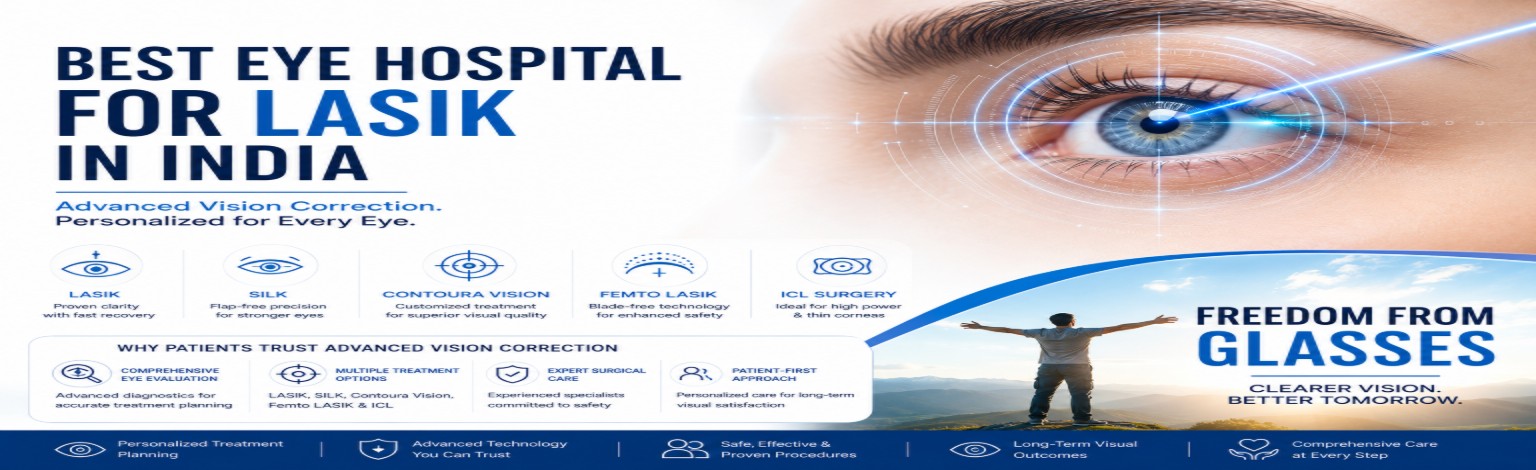
Advanced LASIK, SILK, Contoura Vision, Femto LASIK & ICL Surgery at ICARE Eye Hospital, Noida
For decades, spectacles and contact lenses have helped millions of Indians achieve clear vision. Yet for many people, dependence on eyewear continues to affect daily life. Whether it is a student preparing for competitive examinations, a software professional spending long hours on digital screens, a defence aspirant working toward physical eligibility standards, or a business executive constantly travelling between cities, the desire to experience clear vision without spectacles has never been greater.
This growing demand has transformed laser vision correction into one of the most sought-after elective procedures in modern ophthalmology. However, as awareness has increased, so has confusion.
Patients today encounter numerous terms such as LASIK, Femto LASIK, Contoura Vision, SILK, PRK, and ICL. While every technology claims to offer excellent outcomes, the most important question remains:
Which procedure is actually best for your eyes?
The answer depends on far more than technology alone.
Successful refractive surgery requires comprehensive diagnostics, individualized treatment planning, advanced surgical expertise, and a hospital that places patient suitability above procedural volume.
This is where ICARE Eye Hospital & Post Graduate Institute, Noida has built its reputation.
Located in Sector 26, Noida, ICARE Eye Hospital has become a destination for patients seeking advanced vision correction solutions from across Delhi NCR and various parts of India. With a comprehensive refractive surgery department, advanced diagnostic systems, multiple laser vision correction technologies, and a patient-centric approach, ICARE offers a personalized pathway toward spectacle independence.
Why LASIK Surgery Has Become One of India’s Most Popular Elective Procedures
The way Indians work, study, and live has changed dramatically.
Today, the average individual spends significant hours using:
- Smartphones
- Laptops
- Tablets
- Digital displays
- Online learning platforms
At the same time, increasing participation in sports, fitness activities, defence services, aviation, and professional careers has intensified the desire for visual freedom.
Common challenges faced by spectacle users include:
- Fogging during winters
- Spectacles slipping during exercise
- Contact lens irritation
- Difficulty while travelling
- Frequent prescription changes
- Inconvenience during sports
- Dependency on eyewear for daily activities
Laser vision correction addresses these concerns by correcting the refractive error responsible for blurred vision.
For suitable candidates, it can significantly reduce or eliminate dependence on glasses and contact lenses.
Understanding Refractive Errors
Before discussing LASIK and other advanced procedures, it is important to understand why spectacles are required.
The eye functions similarly to a camera.
Light entering the eye should focus precisely on the retina.
When this focusing mechanism becomes imperfect, refractive errors occur.
Myopia (Nearsightedness)
People with myopia can see nearby objects clearly but experience difficulty seeing distant objects.
Common symptoms include:
- Difficulty reading road signs
- Blurred classroom boards
- Difficulty driving at night
Myopia is increasingly common among students and young professionals.
Hyperopia (Farsightedness)
Hyperopia occurs when light focuses behind the retina.
Patients may experience:
- Eye strain
- Headaches
- Difficulty reading
- Visual fatigue
Astigmatism
Astigmatism develops when the cornea is not perfectly symmetrical.
This can result in:
- Distorted vision
- Shadowing around objects
- Difficulty focusing
Many patients have a combination of myopia and astigmatism.
Modern refractive surgery technologies can address these conditions with high levels of precision.
The Most Important Question: Which LASIK Technology is Best?
One of the biggest mistakes patients make is searching for:
“Best LASIK machine”
instead of asking:
“Which procedure is best for my eyes?”
A technology that works exceptionally well for one patient may not be the ideal choice for another.
Factors influencing treatment selection include:
Corneal Thickness
Some procedures require greater corneal thickness than others.
Corneal Shape
Detailed mapping helps identify irregularities that influence procedure selection.
Tear Film Quality
Patients with dry eye may benefit from certain technologies over others.
Degree of Eye Power
High refractive errors may require alternative solutions.
Lifestyle
Athletes, defence personnel, and physically active individuals may benefit from flap-free procedures.
Occupation
Night drivers, software professionals, pilots, and students often have different visual priorities.
This is why ICARE emphasizes comprehensive diagnostics before recommending any refractive procedure.
Why Choosing the Right Hospital Matters More Than Choosing a Machine
Many patients compare hospitals based only on technology.
However, excellent outcomes depend on several factors working together.
These include:
Advanced Diagnostics
Modern diagnostics help identify the most suitable procedure.
Patient Selection
Not every patient is suitable for LASIK.
Surgical Planning
Customization significantly influences outcomes.
Technology
The technology should match the patient’s needs.
Postoperative Monitoring
Follow-up care remains critical to achieving stable vision.
At ICARE Eye Hospital, every patient undergoes detailed evaluation before a treatment recommendation is made.
The goal is not simply to perform surgery.
The goal is to determine whether surgery is appropriate and, if so, which procedure is likely to deliver the safest and most effective outcome.
LASIK Surgery at ICARE Eye Hospital
LASIK remains one of the most established refractive procedures worldwide.
The procedure reshapes the cornea to correct refractive errors and improve visual clarity.
Benefits include:
- Rapid visual recovery
- Minimal discomfort
- Predictable outcomes
- Long-term stability
Many suitable candidates experience significant reduction in spectacle dependence after treatment.
Despite the popularity of LASIK, modern refractive surgery has evolved beyond conventional approaches.
This has led to the development of highly customized and flap-free procedures.
SILK Vision Correction: The Next Evolution of Laser Eye Surgery
Among the latest advancements in refractive surgery is SILK.
SILK has gained attention because it combines precision, tissue preservation, and a flap-free approach.
Unlike conventional LASIK, SILK avoids creation of a corneal flap.
Advantages include:
- Flap-free treatment
- Preservation of corneal biomechanics
- Minimal tissue disruption
- Rapid recovery
- Enhanced patient comfort
For individuals with active lifestyles, SILK has emerged as an attractive option.
Many athletes and defence aspirants prefer flap-free technologies because they align well with physically demanding activities.
However, suitability must always be determined through comprehensive evaluation.
Contoura Vision: Customized Vision Correction Beyond Standard LASIK
Traditional LASIK primarily corrects spectacle power.
Contoura Vision takes customization further.
Using highly detailed corneal mapping, Contoura Vision evaluates thousands of unique points across the corneal surface.
This enables treatment of:
- Myopia
- Hyperopia
- Astigmatism
- Certain corneal irregularities
Potential benefits include:
- Enhanced visual quality
- Better contrast sensitivity
- Improved night vision
- Reduced glare
For patients who prioritize visual performance, Contoura Vision is often considered among the most sophisticated refractive surgery options available today.
Femto LASIK: Blade-Free Precision
Femto LASIK represents a significant advancement over traditional LASIK.
Instead of using a mechanical blade, a femtosecond laser is used to create the corneal flap.
Benefits include:
- High precision
- Predictable flap creation
- Enhanced safety profile
- Rapid recovery
For many patients, Femto LASIK continues to provide excellent outcomes and remains an important part of modern refractive surgery.
Why Advanced Diagnostics Are Essential Before LASIK
One reason some patients experience suboptimal outcomes elsewhere is inadequate pre-operative assessment.
At ICARE Eye Hospital, diagnostics play a central role in treatment planning.
The evaluation may include:
- Corneal topography
- Corneal tomography
- Tear film analysis
- Wavefront measurements
- Retinal examination
- Refraction assessment
- Ocular surface evaluation
These investigations help determine:
- Whether surgery is suitable
- Which procedure is safest
- What visual outcome can realistically be expected
This scientific approach helps maximize safety and predictability.
A Personalized Approach Instead of a One-Size-Fits-All Model
Every eye is unique.
Therefore, every refractive surgery recommendation should be unique.
At ICARE, treatment decisions are based on:
- Eye anatomy
- Corneal structure
- Lifestyle
- Professional requirements
- Visual goals
Rather than promoting a single technology for every patient, the focus remains on matching the right procedure to the right candidate.
This philosophy is one of the reasons many patients from Noida, Greater Noida, Ghaziabad, Delhi, Gurgaon, Faridabad, Haryana, Punjab, H.P, U.P, Uttarakhand and other states of India choose ICARE for vision correction.
Why ICARE Eye Hospital is Becoming a Preferred Choice for LASIK and Refractive Surgery in India
When patients search for the best eye hospital for LASIK in India, they are not simply looking for a laser machine. They are looking for trust, expertise, safety, technology, and long-term outcomes.
A successful refractive surgery journey begins with choosing a centre that follows a patient-first philosophy.
ICARE Eye Hospital & Post Graduate Institute has developed a comprehensive refractive surgery ecosystem that focuses on:
- Detailed pre-operative evaluation
- Personalized procedure selection
- Advanced diagnostics
- Modern laser vision correction technologies
- Long-term postoperative follow-up
- Ethical patient counselling
Unlike a volume-driven approach where every patient is directed toward a single procedure, ICARE believes that every eye deserves an individualized treatment plan.
This philosophy is particularly important because not every patient is suitable for LASIK.
Some patients may benefit more from SILK.
Others may be ideal candidates for Contoura Vision.
Some may require ICL surgery.
The ability to offer multiple solutions under one roof allows refractive surgeons to recommend the most appropriate treatment based on clinical findings rather than technological limitations.
ICL Surgery: An Alternative When LASIK Is Not Suitable
One of the most important qualities of an advanced refractive surgery centre is knowing when LASIK should not be performed.
Certain patients may have:
- Very high spectacle powers
- Thin corneas
- Irregular corneal structure
- Insufficient corneal tissue
For such individuals, Implantable Collamer Lens (ICL) surgery may provide an excellent alternative.
ICL involves placing a specially designed lens inside the eye while preserving the natural cornea.
Advantages may include:
- Correction of high refractive errors
- Preservation of corneal tissue
- Excellent visual quality
- Reversible nature
Many patients who are told elsewhere that they are “not suitable for LASIK” may still be eligible for advanced vision correction through ICL after comprehensive evaluation.
SILK vs Contoura Vision vs Femto LASIK vs ICL
| Feature | SILK | Contoura Vision | Femto LASIK | ICL |
| Flap Creation | No | Yes | Yes | No |
| Corneal Tissue Removal | Yes | Yes | Yes | No |
| Suitable for High Power | Moderate | Moderate | Moderate | Excellent |
| Customized Treatment | High | Very High | High | N/A |
| Recovery Speed | Fast | Very Fast | Very Fast | Fast |
| Dry Eye Risk | Lower | Moderate | Moderate | Minimal |
| Sports Friendly | Excellent | Good | Good | Excellent |
| Night Vision Quality | Excellent | Excellent | Very Good | Excellent |
| Suitable for Thin Corneas | Limited | Limited | Limited | Often Yes |
| Spectacle Independence | Excellent | Excellent | Excellent | Excellent |
The best procedure is always determined after a detailed eye examination.
Why Patients Travel from Across India to ICARE Eye Hospital
While ICARE is located in Noida, its patient base extends far beyond NCR.
Patients regularly travel from:
Delhi
For advanced laser vision correction and comprehensive eye care.
Haryana
Including Gurgaon, Faridabad, Sonipat, Panipat, Karnal, Ambala and Kurukshetra.
Uttar Pradesh
Including Noida, Greater Noida, Ghaziabad, Meerut, Aligarh, Agra and Lucknow.
Punjab
Patients seeking advanced refractive surgery evaluation.
Uttarakhand
Individuals looking for specialized eye care and customized vision correction.
The hospital’s accessibility, comprehensive services and reputation in ophthalmology contribute to its growing patient base.
Who Should Consider Laser Vision Correction?
Laser vision correction may be suitable for:
Students
Preparing for academic and professional opportunities.
Defence Aspirants
Seeking freedom from spectacles during physical training.
Corporate Professionals
Working long hours on digital devices.
Entrepreneurs
Travelling frequently and seeking convenience.
Healthcare Workers
Who prefer not to rely on spectacles during professional duties.
Athletes
Looking for unrestricted performance.
Frequent Travellers
Who wish to reduce dependence on glasses and contact lenses.
The Future of Refractive Surgery
Modern refractive surgery is moving toward greater personalization.
Future advancements are increasingly focused on:
- Individual eye characteristics
- Corneal biomechanics
- Visual quality
- Artificial intelligence-assisted diagnostics
- Customized treatment planning
The era of one-size-fits-all LASIK is gradually being replaced by personalized refractive surgery.
Hospitals that invest in comprehensive diagnostics and individualized treatment strategies are likely to deliver superior patient experiences.
Why Comprehensive Eye Evaluation Matters More Than Technology Names
Many patients spend weeks researching procedures online.
However, the most important step remains a detailed consultation.
Two patients with the same spectacle number may require completely different procedures because of differences in:
- Corneal thickness
- Corneal shape
- Ocular surface health
- Lifestyle
- Professional requirements
- Visual expectations
This is why treatment recommendations should always be based on clinical findings rather than internet trends.
Why ICARE’s Approach Aligns with Modern Eye Care
Modern ophthalmology emphasizes evidence-based decision making.
At ICARE Eye Hospital, refractive surgery planning focuses on:
Safety
Patient suitability remains the primary consideration.
Precision
Advanced diagnostic technology supports treatment planning.
Personalization
Recommendations are tailored to individual needs.
Long-Term Outcomes
The objective is not simply immediate visual improvement but sustained visual quality over time.
Medical Review Team
Dr. Saurabh Choudhry
Director – Cataract & Refractive Services
MD, DO, DNB, SRTF (Sankara Nethralaya), FERC
Special interests include:
- Refractive surgery
- SILK Laser
- Contoura Vision
- Cataract surgery
- Customized vision correction
Dr. Ambarish P. Toshniwal
Head – Refractive Services
MBBS, DNB (Sankara Nethralaya), FRCS (UK), PGDHHM
Areas of expertise include:
- LASIK surgery
- Corneal evaluation
- Refractive diagnostics
- Personalized vision correction planning
Frequently Asked Questions About LASIK and Refractive Surgery
1. Which is the best eye hospital for LASIK in India?
Patients should evaluate surgeon expertise, diagnostics, technology and clinical outcomes before making a decision.
2. Is LASIK permanent?
The correction is generally permanent, although age-related vision changes can occur later.
3. What is the latest vision correction technology?
Advanced technologies include SILK and highly customized refractive treatments.
4. Which is better: SILK or LASIK?
Suitability depends on individual eye characteristics.
5. Is Contoura Vision better than conventional LASIK?
Contoura Vision offers highly customized treatment for suitable candidates.
6. What is Femto LASIK?
A blade-free LASIK procedure that uses femtosecond laser technology.
7. Can high powers be corrected?
Many high refractive errors can be corrected through LASIK, SILK or ICL depending on eligibility.
8. What is ICL?
ICL is an implantable lens procedure used for vision correction.
9. Is LASIK painful?
No. Numbing eye drops are used during treatment.
10. How long does LASIK take?
Typically 10–20 minutes for both eyes.
11. Can I use my mobile after surgery?
Usually after initial recovery as advised by your surgeon.
12. Is LASIK safe?
When performed in suitable candidates after comprehensive evaluation, LASIK is considered safe.
13. What is the minimum age for LASIK?
Generally 18 years with stable spectacle power.
14. Can LASIK correct cylindrical power?
Yes.
15. Which procedure causes less dry eye?
Flap-free procedures may reduce dry-eye symptoms in some patients.
16. Can defence candidates undergo LASIK?
Eligibility depends on current recruitment guidelines.
17. Can athletes undergo LASIK?
Yes, following proper evaluation.
18. How soon can I return to work?
Many patients resume routine activities within a few days.
19. What if I am not suitable for LASIK?
ICL or other alternatives may be considered.
20. How do I schedule a consultation?
You can contact ICARE Eye Hospital directly.
Contact ICARE Eye Hospital & Post Graduate Institute
Address
E3A, ICARE Eye Hospital Road, Block E, Sector 26, Noida, Uttar Pradesh 201301
Phone
0120 358 6666
Website: https://www.icarelasik.com
Final Thoughts
Choosing the best eye hospital for LASIK in India involves much more than selecting a technology.
The ideal hospital combines advanced diagnostics, multiple treatment options, experienced specialists, patient-centered care, and a commitment to long-term visual outcomes.
ICARE Eye Hospital Noida offers a comprehensive refractive surgery program that includes LASIK, SILK, Contoura Vision, Femto LASIK and ICL, enabling personalized treatment recommendations for each patient.
For individuals seeking freedom from spectacles and contact lenses, a comprehensive refractive surgery evaluation can be the first step toward clearer, sharper and more confident vision.