

 LASIKSelf Test!
 Call Now9910430391
 BookAppointment
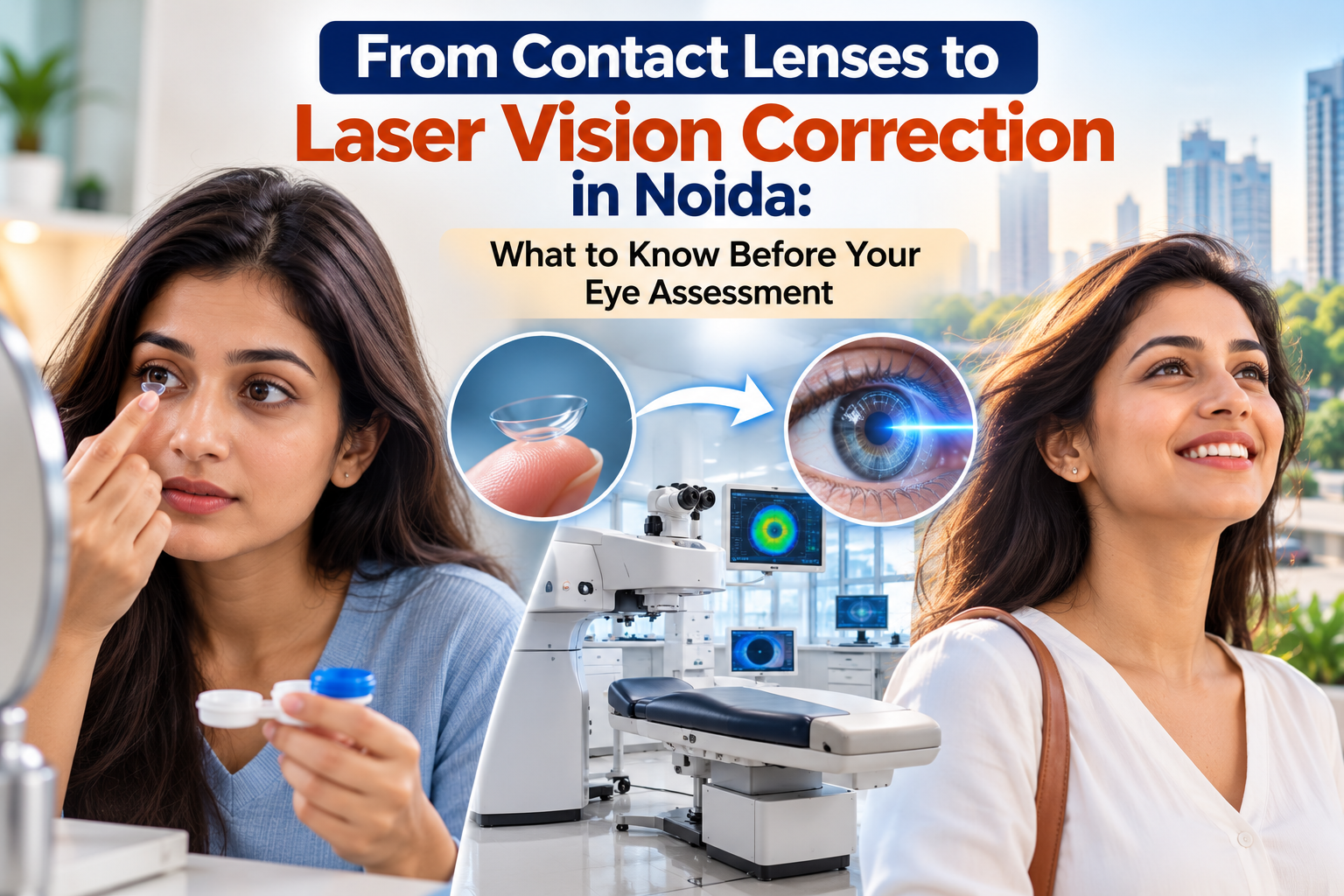
Thinking about LASIK after years of wearing contact lenses? The first decision is not whether to choose a named laser technique. It is whether your eyes can be measured accurately, whether the cornea and tear film are healthy, and whether a procedure is appropriate for your prescription and visual goals. This guide explains what contact lens users in Noida should discuss with an eye doctor before considering blade-free LASIK, Contoura Vision, SILK or other refractive options.
People searching for a LASIK hospital in Noida or an eye hospital in Noida often compare procedure names first. For contact lens wearers, however, the preparation before diagnostic testing can be just as important as the treatment discussion. Lenses may temporarily influence corneal shape, and symptoms that feel like ordinary contact lens discomfort may be signs of an ocular-surface issue requiring attention.
Why your contact lens history matters before LASIK screening
The cornea is the transparent front surface of the eye. Its curvature helps focus light, and laser refractive procedures change its optical power. A contact lens sits directly over this surface. Depending on lens type, fit and duration of use, it can temporarily alter the shape of the cornea. This means measurements taken too soon after lens removal may not fully represent the eye’s usual shape.
Refractive-surgery planning depends on measurements that are precise and repeatable. A doctor may postpone final testing until the cornea has stabilised. That is not an unnecessary delay. It protects the quality of the measurements on which suitability and treatment planning depend. A person whose spectacle power has been stable for years can still need a period without contact lenses before corneal mapping.
Bring details of the type of lenses you wear, how many hours you use them, when you last wore them, and whether you sometimes sleep in them. Also mention discomfort, intermittent blur, redness and previous contact lens-related infections. Do not assume these details are irrelevant because vision appears clear when the lenses are in place.
How long should you stop wearing contact lenses before a refractive evaluation?
There is no single safe stop-wearing interval for everyone. Soft lenses, toric soft lenses, rigid gas-permeable lenses and specialty lenses may affect the cornea differently. The recommended interval also depends on previous wear patterns and the stability of repeated measurements. Some patients need more than one assessment before the ophthalmologist can be confident that their corneal shape is stable.
Ask the eye-care team for instructions based on the exact lenses you use. If the appointment is already scheduled, contact the hospital before changing your routine, particularly if you rely on lenses for work or driving. Use spectacles during the lens-free period when advised. Do not resume contact lenses between measurements without telling the clinical team, because this can affect interpretation.
The U.S. Food and Drug Administration advises people considering LASIK to switch from contact lenses to glasses before the baseline evaluation as directed, because lenses can change corneal shape for a period of time. The important principle is verified stability, not simply reaching a number of days on a calendar.
Dry eyes: a common reason to assess the ocular surface first
Contact lens discomfort can be related to dry eye, meibomian gland dysfunction, allergy, eyelid inflammation, lens fit or environmental exposure. Air-conditioned offices, prolonged screen use and reduced blinking may make symptoms more noticeable. Dry eye may also exist without dramatic symptoms. That is why a refractive consultation should ask about both comfort and signs observed during examination.
An unstable tear film can create fluctuating vision and distort measurements of the front of the eye. It may also influence healing and visual comfort after certain laser procedures. For a person already experiencing burning, grittiness, excessive watering or blurred vision late in the day, discussing dry eye before elective laser surgery is particularly important.
An ophthalmologist may examine the eyelids, assess the ocular surface with a slit lamp, check tear stability and recommend treatment before taking final refractive measurements. Depending on the diagnosis, care might involve modifying screen habits, appropriately selected lubricating drops, eyelid hygiene or prescription treatment. Do not self-medicate with steroid eye drops or assume that using more over-the-counter drops is always the solution.
What tests help determine suitability for blade-free LASIK surgery in Noida?
Vision, refraction and prescription stability
The doctor checks distance and near vision and measures spectacle power. Previous prescriptions can help establish whether that power has been reasonably stable. Refractive changes may affect treatment planning, and an unstable prescription is a reason to delay or reconsider elective surgery.
Corneal topography, tomography and thickness
Corneal topography maps the surface curvature, while tomography provides additional information about corneal structure, including aspects of the front and back surfaces. Pachymetry measures corneal thickness. Together with the proposed correction, these findings help assess the safety of changing corneal tissue. An irregular or structurally vulnerable cornea may make a corneal laser procedure unsuitable even when spectacle power is within a treatable range.
Tear film, eyelids and corneal surface
The examination looks for dryness, inflammation, scarring, contact lens-related changes and other conditions that can affect measurement accuracy or recovery. Addressing treatable ocular-surface disease before considering surgery can be important. A patient with severe or poorly controlled dry eye may be advised against LASIK.
Eye pressure, lens and retinal assessment
Suitability is not decided by the cornea alone. A comprehensive examination may include intraocular pressure, the natural lens and the retina. Some people with higher levels of myopia have additional retinal risks. A dilated retinal assessment may be advised, particularly where clinical findings or history justify it. Cataract or another eye disease may require a completely different treatment plan.
For general information about the eye hospital’s laser service, see ICARE’s LASIK page: https://www.icarehospital.org/lasik/. For corneal assessment and related conditions, see its cornea department: https://www.icarehospital.org/doctor-department/cornea/.
Blade-free LASIK, Contoura Vision, SILK and ICL: why the names are not interchangeable
These terms refer to different approaches, not to equivalent versions of the same treatment. The suitability criteria, recovery patterns, treatment limitations and risks can differ. A surgeon should explain which procedure, if any, matches your measurements and circumstances. A marketing label alone cannot establish medical suitability.
Blade-free or femtosecond LASIK
In femtosecond LASIK, a laser creates a corneal flap and an excimer laser reshapes underlying corneal tissue. The technique avoids using a mechanical blade to create the flap, but it still involves a flap and still requires careful corneal screening. Potential issues include dry eye, glare or halos, under- or over-correction, flap-related complications and rare corneal weakening. The term blade-free should never be interpreted as risk-free.
Contoura Vision and topography-guided approaches
Topography-guided approaches use information about corneal shape to help guide selected treatments. Their value depends on the characteristics of the eye and the particular planning system. They are not automatically preferable for all patients. Even when a technology can produce a highly individualised treatment map, the safety of the cornea and the stability of measurements remain central.
SILK and lenticule-based laser surgery
SILK is a lenticule-based refractive procedure. Instead of creating a LASIK-style flap, it removes a small tissue lenticule through a limited incision. It has its own candidacy criteria and possible side effects. Whether it suits a particular degree of myopia or astigmatism depends on the relevant technology indications and findings of a detailed eye examination.
Implantable collamer lens (ICL) surgery
ICL is an intraocular, lens-based approach and does not reshape the cornea in the same way as LASIK. It may be discussed for some patients whose prescription or corneal measurements make laser surgery less suitable. However, it also requires its own measurements, including assessment of the space inside the eye, and carries intraocular surgical risks. It should not be regarded as an automatic fallback for everyone told not to undergo LASIK.
The main decision is clinical: not “which procedure is newest?” but “what is appropriate for my eyes, and what are the alternatives if surgery is not advisable?”
A practical preparation checklist for contact lens wearers
Before you attend a refractive consultation, contact the clinic for lens-discontinuation instructions; keep your current glasses available; bring older spectacle prescriptions; list any prescription or over-the-counter eye drops; and mention prior infections, red-eye episodes or corneal ulcers. Tell the doctor about diabetes, autoimmune conditions, medicines, pregnancy or breastfeeding when applicable, and any past eye surgery.
Think through daily vision needs. Do you drive after dark? Work long hours at a screen? Spend time in dusty environments? Play contact sports? Need precise near vision for work? Such details may affect discussion of possible side effects, recovery planning and whether non-surgical correction remains a more suitable choice.
Do not promise yourself a fixed surgery date before screening. Some people need treatment for the ocular surface, repeat measurements or an evaluation by another ophthalmic subspecialist. Others may find that spectacles or contact lenses continue to be the more appropriate option.
What does a decision-focused consultation actually sound like?
A useful consultation should explain what the tests show in plain language. You should understand whether your corneal thickness and shape are suitable, whether your prescription is stable, and whether ocular-surface treatment is required. Ask what change in vision is reasonably expected, which visual tasks might still require glasses, and what could make recovery slower than anticipated.
Informed consent should cover alternatives as well as benefits. LASIK and other refractive interventions are elective for many patients. It is reasonable to request clarification or another opinion before proceeding. Do not interpret a recommendation against laser surgery as a failure. It may reflect an appropriate decision to avoid an unnecessary risk.
It is also important to understand that refractive surgery does not prevent future age-related changes to the eye. Presbyopia may create a need for reading glasses, while cataract, glaucoma and retinal disease can develop independently of the earlier refractive treatment. Follow-up and routine eye care remain relevant even if distance vision improves.
When contact lens symptoms need prompt medical attention
A painful red eye in a contact lens wearer needs particular attention because a corneal infection can sometimes progress quickly. Remove the contact lens and seek prompt professional evaluation if you develop significant pain, redness, light sensitivity, discharge or reduced vision. Do not reuse the lens or case until advised. Do not try to mask symptoms with leftover medication.
Sudden loss of vision, a new curtain-like shadow, flashes accompanied by a marked increase in floaters, chemical exposure and significant eye trauma also require urgent assessment rather than a routine elective LASIK booking. These problems need diagnosis on their own terms, regardless of whether you were considering laser correction.
Why the location of your eye hospital in Noida still matters
Patients often start with searches such as “LASIK hospital near me”, “eye doctors in Noida” or “eye hospital near me”. Convenient access is relevant because screening and follow-up may involve more than one visit. However, convenience should be considered alongside the availability of appropriate eye examinations, corneal assessment and a clear follow-up plan.
ICARE Eye Hospital & Post Graduate Institute lists its Sector 26 hospital in Noida and provides ophthalmic services including LASIK, cornea, cataract, retina and glaucoma care. Its official website provides information on contact lens services at https://www.icarehospital.org/contact-lens/ and appointment requests at https://www.icarehospital.org/booking-appointment/. These pages can help patients navigate services, but suitability must be determined during an individual medical consultation.
Frequently asked questions
Possibly. Contact lens use does not automatically exclude LASIK, but lenses may affect corneal measurements. Follow the surgeon’s instructions on lens discontinuation and undergo appropriate screening.
Sometimes an initial assessment can occur, but final planning may need a longer break and repeat measurements. The appropriate interval depends on the lens type and evidence that corneal shape has stabilised.
Not always. Some ocular-surface problems can be treated and reassessed. Severe or uncontrolled dry eye may make LASIK inappropriate. Your ophthalmologist should explain the findings and the risks.
Numbing drops are normally used, but pressure or temporary discomfort can occur. Blade-free describes flap creation; it does not remove all surgical risks or guarantee a particular visual outcome.
Reviews cannot substitute for corneal scans, refraction and a clinical examination. Topography-guided treatment should be considered only when the surgeon finds it appropriate for your eyes.
Suitability depends on the treatment range of the device and your corneal measurements, eye health and prescription. Not every high prescription can be safely treated with a corneal laser technique.
No. ICL requires separate measurements and intraocular risk assessment. It may be appropriate for some people, while others may be advised to continue with glasses or contacts.
Do not stop prescribed medication on your own. Inform the clinic about every drop you use, and follow instructions from the treating ophthalmologist.
Bring current spectacles, past prescriptions, contact lens details, previous eye reports, medication history and a summary of symptoms. Ask in advance whether dilation or additional testing is planned.
Use the official appointment page or call the Sector 26 appointment number. Explain that you wear contact lenses and request instructions before coming for refractive screening.
Appointment information: ICARE Eye Hospital & Post Graduate Institute
Address: E3A, Sector 26, Noida, Uttar Pradesh 201301. Sector 26 appointment number: +91-9811880015. Hospital switchboard: +91-120 3586666 / 600 / 601 / 602. Website: https://www.icarehospital.org/. Appointment request: https://www.icarehospital.org/booking-appointment/. Please confirm the relevant clinic, test preparation and consultation timing before travelling.
Conclusion
For contact lens wearers exploring LASIK in Noida, a careful pre-surgery assessment is more useful than selecting a procedure name in advance. Stable corneal measurements, a healthy ocular surface, suitable anatomy and realistic expectations are the foundation of a responsible treatment decision. Whether the eventual recommendation is blade-free LASIK, another refractive procedure, management of dry eye or continued use of glasses, the outcome of screening should be a clear explanation of what is appropriate for your individual eyes.
Medical reference sources (editorial verification)
American Academy of Ophthalmology, LASIK patient guidance: https://www.aao.org/eye-health/treatments/lasik
FDA, What should I expect before, during, and after LASIK surgery?: https://www.fda.gov/MedicalDevices/ProductsandMedicalProcedures/SurgeryandLifeSupport/LASIK/ucm061270.html
American Academy of Ophthalmology EyeWiki, Preoperative Evaluation for LASIK Surgery: https://eyewiki.aao.org/Preoperative_Evaluation_for_LASIK_Surgery